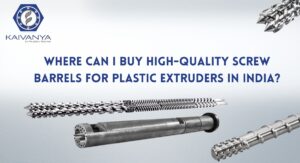


screw barrel is the plasticizing assembly that prepares raw polymer for extrusion, injection molding, blow molding, compounding, or recycling. It combines a rotating screw with a close-fitting heated barrel to receive pellets, powder, flakes, or regrind, then convey, melt, mix, and pressurize the material. Machine owners, production engineers, purchasing teams, and maintenance specialists all rely on this component for stable processing. If you are asking what a screw barrel is, the buying takeaway is straightforward: its geometry, material, and condition directly influence melt quality, output, and part consistency, making correct selection essential when replacing or upgrading worn equipment.
How Does a Screw and Barrel Work?
The assembly pairs a precision-machined helical screw with a cylindrical barrel, heating zones, and temperature sensors. As the screw rotates, its flights move resin through feed, transition, and metering sections. Barrel heat and mechanical shear soften or melt the polymer, while the screw mixes it and builds pressure for the die or mold. In injection molding, a reciprocating screw also moves axially to deliver each shot. Extrusion screws operate continuously, while intermeshing twin screws provide stronger mixing for compounding and devolatilization. Available categories include single, parallel twin, and conical twin designs, plus barrier, mixing, vented, and recycling profiles. The key differentiator is how well the geometry and metallurgy match the application.
Key Features of a High-Quality Screw Barrel
Common material options include nitrided alloy steel, bimetallic-lined barrels, hardfaced screw flights, and through-hardened tool steels. Selection depends on abrasion, corrosion, adhesion, polymer chemistry, and filler content. Important design features include controlled screw-to-barrel clearance, accurate flight geometry, a straight and concentric bore, tailored compression, mixing sections, feed openings, vents, heater zones, and thermocouple provisions. Screw diameter, effective length, L/D ratio, and drive or discharge interfaces can be customized to the machine. Designs may support PE, PP, PVC, PET, ABS, PA, PC, engineering compounds, and recyclate when correctly specified. Temperature, torque, and pressure capability must be verified for the complete machine; they are not universal screw-barrel ratings.
Benefits for Plastic Processing Operations
A correctly specified screw barrel creates a more uniform melt, helping the process maintain throughput, shot weight, color dispersion, surface finish, and dimensional consistency. Suitable metallurgy slows abrasive or corrosive wear and helps preserve the designed clearance, reducing unplanned adjustments, maintenance frequency, and emergency replacement risk. Accurate OEM-compatible dimensions simplify installation because the drive, feed throat, heaters, sensors, and downstream connection align with existing equipment. Application-matched geometry can also limit excessive shear, thermal stress, and residence time, protecting sensitive polymers and reducing avoidable scrap. For operators, a stable plasticizing unit provides a wider process window while supporting safe operation within approved temperature, speed, torque, and pressure limits.
Screw Barrel Applications and Industries
Screw barrels serve nearly every process that must convert solid polymer into a consistent melt. Injection molders use them for packaging, automotive, medical, electrical, appliance, and consumer components. Extruders need them for pipe, profile, film, sheet, wire insulation, cable coating, and pellet production. Blow molders rely on stable plasticizing for bottles, containers, and technical hollow parts. Compounders use twin-screw systems to disperse pigments, blend polymers, add fillers or fibers, and remove volatiles. Recyclers process flakes, regrind, and agglomerate through wear-resistant, vented designs. The correct choice follows the processing problem: high purity, gentle melting, intensive mixing, improved feeding, corrosion control, filler resistance, degassing, or reliable pressure generation before a die, filter, or mold.
What Technical Specifications Should Buyers Check?
| Specification | Details / Requirement |
|---|---|
| Product Type | Screw Barrel Assembly |
| Screw Diameter | Machine model and application specific |
| Working Length | As per machine design |
| L/D Ratio | Application and machine specific |
| Flight Geometry | Standard, barrier, mixing, or application-specific design |
| Compression Ratio | Polymer and processing requirement dependent |
| Mixing Design | Dispersive / distributive / application-specific |
| Barrel Bore | Matched to screw diameter and required clearance |
| Critical Clearances | As per approved component drawing and machine OEM specification |
| Drive Coupling | Compatible with existing machine drive |
| Mounting Dimensions | As per machine OEM drawing |
| Nozzle / Die-End Details | Machine and tooling specific |
| Base Material | 38CrMoAlA, EN41B, 42CrMo, H13 / SKD61, or application-specific material |
| Liner / Hard-Facing Alloy | Tungsten carbide, nickel-based, cobalt-based, Colmonoy, or application-specific alloy |
| Surface Treatment | Nitriding, hard-facing, bimetallic lining, or specified treatment |
| Hardness | As specified according to material, coating, and application |
| Heater Locations | As per barrel design and machine configuration |
| Sensor Locations | As per machine temperature-control arrangement |
| Cooling Arrangement | Air or liquid cooling, depending on machine design |
| Processed Resin Compatibility | Must be verified against the specific polymer formulation |
| Glass-Fiber Processing | Material and wear protection selected according to fiber loading |
| Flame-Retardant Materials | Alloy and surface treatment selected according to formulation |
| Recycled Content | Design selected according to recycled material characteristics |
| Corrosive Additives | Corrosion-resistant material/alloy selection required |
| Allowable Melt Temperature | As approved by machine OEM, resin supplier, and component design |
| Maximum Rotational Speed | As specified for the machine and screw design |
| Maximum Torque | As specified by the machine drive and approved screw design |
| Operating Pressure | Application and machine design dependent |
| Drawing Tolerances | As per approved engineering drawing |
| Final Configuration | Confirmed after machine, polymer, throughput, and operating-condition review |
How to Choose a Screw Barrel Manufacturer or Supplier
Choose a supplier that requests your polymer, additives, filler percentage, output target, machine details, and current wear symptoms before recommending a product. Important capabilities include application review, drawing or sample measurement, compatible screw-and-barrel material selection, material traceability, hardness testing, and dimensional inspection. Ask whether repair, relining, or full replacement offers the best lifecycle value. Before placing an order, confirm drawing approval, quality records, manufacturing lead time, protective packaging, installation guidance, and after-sales technical support. Compare suppliers on documented compatibility and total operating cost—not only the lowest screw barrel price or an unsupported promise of longer service life.
Contact Us
Need a replacement or custom screw barrel for your plastic processing machine? Send the machine make and model, drawing or sample dimensions, polymer and filler details, operating conditions, output target, and wear problem. Request product details or talk to a screw barrel specialist to compare suitable geometry, materials, surface treatments, lead time, and pricing.