

What Is a Bimetallic Twin Barrel and Why Is It Used?
A bimetallic twin barrel is a twin extruder barrel designed with a strong outer body and wear- or corrosion-resistant protection on the internal processing surfaces. It houses and guides a matched screw pair while containing material, temperature, and melt pressure during extrusion. PVC plants, compounders, masterbatch producers and recyclers consider this construction when abrasive fillers, fibres, pigments or corrosive additives cause rapid bore wear. The main reason to upgrade is sustained process control. Correct liner metallurgy and accurate bore geometry can help preserve operating clearance, mixing performance and output consistency for longer under approved production conditions.
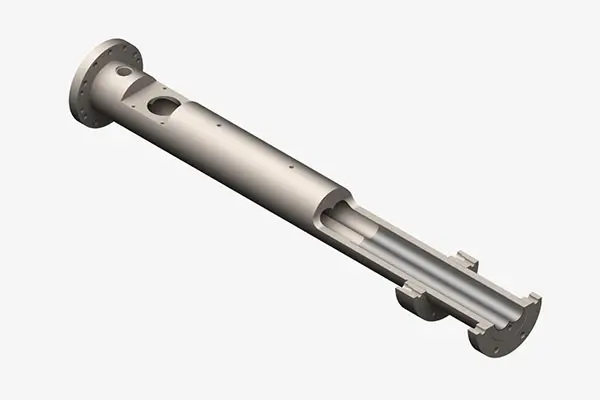
How a Bimetallic Twin Screw Barrel Is Constructed and Operated
The barrel body provides structural strength, while the twin-bore working surfaces use a compatible bimetallic liner, layer, or hardened insert selected for the formulation. The matched screws rotate inside these bores, conveying and mixing material through feed, heating, cooling, venting and discharge zones. Available products include parallel and conical barrels, monoblock bodies, segmented sections and designs with replaceable liners. Feed openings, vacuum ports, side-feeder interfaces and thermocouple connections can be incorporated where required. Key differences include body material, liner alloy, bonding or installation method, protected area, hardness profile, bore finish, centre distance, dimensional tolerances and compatibility with the existing screw pair, heaters, gearbox and die connection.
Key Features of a Wear-Resistant Bimetallic Twin Barrel
A dependable barrel combines a rigid alloy-steel housing with application-selected protection across high-wear internal surfaces. Precision twin-bore machining maintains centre distance, straightness, concentricity and the required screw-to-barrel clearance. Options may include full-length protection, replaceable liners, protected feed zones and matching bimetallic screws. Heater locations, internal cooling passages, thermocouple threads, vacuum vents and side-feed ports are positioned according to the approved machine drawing. Parallel, conical and segmented designs are available in model-specific sizes. Before purchase, verify liner composition, hardness, treatment depth, operating temperature, maximum melt pressure, surface finish, dimensional inspection, and compatibility with the processed resin, filler content, and original extrusion equipment.
Hardening Process of Twin Barrel Set
| Extrusion Heat Treatment | Spin Cast Inlay Layer Bimetallic Barrel |
| Gas Nitrided/ Plasma Nitrided | Boron inlay layer 1.5 to 2mm |
| PM Tool steel vacuum hardened | Tungsten (10 to 35 %) inlay layer 1.5 to 2mm |
| Hard Chrome/Tin Plating | PM Tool steel vacuum hardened throughout hardened |
Benefits of Installing a Bimetallic Twin Screw Barrel
Suitable bimetallic protection can slow bore enlargement in abrasive or corrosive service, helping the barrel maintain effective clearance around the screw pair. Stable clearance supports consistent conveying, mixing, pressure development and finished-product quality as operating hours increase. Longer wear life may reduce replacement frequency, emergency stoppages and maintenance expenditure compared with an unsuitable barrel material. Accurate flanges, ports and heating-zone locations simplify installation on the existing machine. Timely replacement can also protect valuable screws from contact or misalignment caused by excessive bore wear. Inspection reports provide a reliable dimensional baseline, making future wear monitoring, preventive maintenance, and replacement planning easier for production and engineering teams.
Bimetallic Twin Barrel Applications in PVC and Plastic Compounding
Bimetallic barrels are selected for extrusion processes where standard bore surfaces face sustained wear. Filled PVC pipe, profile, and cable-compound lines may require protection against mineral-loaded formulations. Masterbatch manufacturers use wear-resistant twin bores for high pigment, calcium-carbonate and additive concentrations. Engineering-plastic compounders process glass fibre, minerals and performance modifiers that can accelerate barrel wear. Recycling extruders may benefit when approved reclaimed polymers contain abrasive fractions or variable contamination. Parallel barrel segments support many co-rotating compounding lines, while conical designs serve selected counter-rotating PVC machines. Food-contact or medical use requires separate verification of alloy suitability, cleanability, documentation, and compliance before the barrel is approved for production.
Bimetallic Twin Barrel Specifications and Customization Requirements
| Technical parameter | Specification requirement |
|---|---|
| Product type | Wear-resistant bimetallic twin-bore extruder barrel |
| Barrel geometry | Parallel or conical twin bore |
| Construction | Monoblock or modular segmented barrel |
| Barrel-body material | Approved heat-treated alloy steel |
| Bore protection | Bimetallic liner, hard-alloy layer or replaceable wear insert |
| Liner alloy | Selected according to abrasion, corrosion and processed formulation |
| Protected area | Full working bore or application-specific high-wear zones |
| Bore diameter | Matched to the approved screw diameter |
| Centre distance | Matched to screw pair and gearbox geometry |
| Working and overall length | As per approved machine drawing |
| Liner thickness | Defined by barrel design and application requirements |
| Hardness range | Verified through approved material and hardness reports |
| Bore surface finish | Specified in the drawing and inspection plan |
| Straightness and concentricity | Inspected against agreed tolerances |
| Screw-to-screw clearance | Verified for the matched screw pair |
| Screw-to-barrel clearance | Defined for operating temperature and thermal expansion |
| Barrel sections | Feed, closed, vented, side-feed and discharge sections |
| Heating system | Band, cast or cartridge heaters with independent zones |
| Cooling system | Internal water passages or approved air-cooling arrangement |
| Temperature sensing | Thermocouple or other approved sensor connections |
| Feed opening | Customized for hopper or feeder interface |
| Side-feeder port | Optional flange for powders, fibres or additives |
| Venting | Atmospheric or vacuum-degassing connections |
| Discharge connection | Customized die or adapter flange |
| Operating temperature | Material- and model-specific |
| Maximum melt pressure | Confirmed through the approved barrel and die design |
| Pressure class | Not applicable; specify maximum allowable process pressure |
| Material compatibility | PVC, masterbatch, filled polymers, recycled or approved compounds |
| Customization | Liners, ports, flanges, zones, reverse engineering and matching screws |
| Inspection | Bore dimensions, centre distance, finish, hardness and clearances |
| Documentation | Approved drawing, material certificates, hardness report and inspection record |
How to Select a Bimetallic Twin Barrel Manufacturer in India
Choose a bimetallic twin barrel manufacturer that reviews the formulation, wear pattern, machine model, screw condition, and existing barrel drawing before proposing metallurgy. Ask how the body, liner alloy, bonding method, hardness, and twin-bore tolerances will be controlled. A qualified bimetallic twin screw barrel manufacturer in India should provide drawing approval, material traceability, hardness results, bore inspection, and written acceptance criteria. Compare suppliers on liner expertise, twin-bore machining, screw-and-barrel matching, reverse engineering, delivery planning, and technical support rather than selecting only the lowest bimetallic twin barrel price.
Request a Bimetallic Twin Barrel Price and Replacement Review
Need a replacement barrel for a PVC, compounding or recycling extruder? Share the machine model, existing drawing, screw dimensions, processed formulation, filler percentage, bore-wear readings, and photographs. Contact Us Today for an application-based liner recommendation, confirmed manufacturing scope, delivery estimate, and commercial proposal.