

What Is an Extruder Machine?
Extruder machine is a key piece of equipment used to convert plastic, polymer, food, and other processable materials into continuous products with a controlled shape and consistent quality. The machine works by feeding raw material into a heated barrel, where an extruder screw conveys, compresses, melts, mixes, and prepares the material before pushing it through a specially designed die.
For manufacturers, choosing the right extrusion machine is about more than production capacity. Screw design, barrel construction, heating and cooling control, drive power, feeding accuracy, die compatibility, material characteristics, and expected output all influence the final result.
Kaivanya Extrusion provides application-focused extrusion solutions designed around the actual production requirements of processors, machine builders, manufacturers, and industrial users. Whether you need a single screw extruder, twin screw extruder, plastic extruder machine, PVC extruder machine, food extruder machine, or filament extruder, the machine configuration should be selected according to the material and finished product.
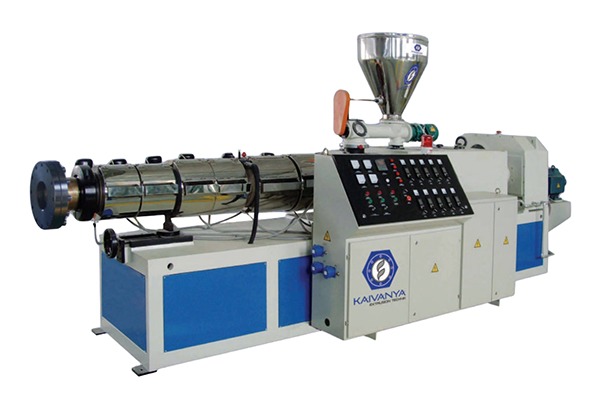
Single Screw and Twin Screw Extruder Machine Solutions
A complete extrusion line normally consists of a feeding system, drive and gearbox, heated or cooled barrel, extruder screw and barrel, die, control system, and downstream equipment. Each component has an important role in maintaining stable processing and consistent production.
Single screw extruder machine is widely used when the material requires reliable conveying, melting, and controlled extrusion. It can be configured for applications such as pipes, profiles, sheets, films, tubing, cables, and other continuous plastic products.
Twin screw extruder machine provides enhanced mixing, conveying, and compounding capability. It is particularly useful for applications involving masterbatch, filled polymers, additives, complex formulations, and materials that require controlled mixing and dispersion.
The right extrusion machine depends on several factors, including raw material, required production capacity, product dimensions, melt temperature, pressure, screw configuration, and downstream requirements. Instead of selecting a machine only by advertised output, manufacturers should evaluate the complete process.
Key Features of a High-Performance Plastic Extruder Machine
A reliable plastic extruder machine begins with a mechanically robust design and accurately matched processing components. The screw and barrel must be manufactured from suitable materials and designed according to the polymer, additives, fillers, operating conditions, and expected production load.
Modern extrusion systems can include independently controlled heating and cooling zones for accurate temperature management. Depending on the application, the machine may also incorporate gravimetric or volumetric feeding, vacuum venting, melt filtration, pressure monitoring, automated controls, and specialized downstream equipment.
Important selection factors include screw diameter, L/D ratio, compression ratio, screw profile, motor capacity, gearbox design, barrel metallurgy, die requirements, line speed, and cooling capacity.
For demanding applications such as PVC processing, filled compounds, abrasive formulations, or corrosive materials, appropriate screw and barrel metallurgy can significantly influence component life and maintenance requirements. Options such as nitrided alloy steel, wear-resistant materials, corrosion-resistant construction, and bimetallic barrels may be considered according to the application.
Why Choosing the Right Extruder Machine?
The correct extrusion machine can make a significant difference to production consistency, product quality, operating efficiency, and maintenance requirements.
A properly designed screw provides controlled material conveying, melting, mixing, and pressure development. Stable feeding and accurate temperature control help maintain consistent processing conditions, reducing variations in product dimensions and surface finish.
A machine configured for the actual application can also help reduce unnecessary material waste and avoid excessive mechanical or thermal stress. Wear-resistant screw and barrel construction may provide longer service life when processing abrasive or demanding materials.
Modern control systems make it easier for operators to monitor important parameters such as screw speed, motor load, barrel temperature, melt temperature, and pressure. Recipe management, alarms, interlocks, and data monitoring can further improve process repeatability.
For manufacturers planning future expansion, a properly selected extrusion line can also provide a more practical foundation for increasing production capacity or adding new product configurations.
Industrial Applications of Plastic, PVC, Food and Filament Extruders
Extrusion technology is used across a wide range of industries because it can continuously manufacture products with controlled dimensions and repeatable characteristics.
Plastic extruder machine manufacturer in India can configure extrusion equipment for products such as plastic pipes, profiles, sheets, tubing, cable insulation, seals, films, and other continuous polymer products.
PVC extruder machine is commonly configured for PVC pipes, profiles, channels, cable applications, and other PVC products. Because PVC formulations can vary significantly, screw geometry, temperature control, material handling, and wear resistance should be selected according to the specific formulation.
Filament extruder machine is designed for producing filament with controlled diameter and consistent material properties. Accurate extrusion, cooling, pulling, and winding are important for applications where dimensional consistency is critical.
Food extruder machine can be designed for suitable food-processing applications such as snacks, cereals, pet food, textured products, and other formulated materials. Food-contact materials, hygiene requirements, temperature control, cleaning access, and process conditions should be considered during machine selection.
Specialized extrusion systems can also be developed for extruded profiles, extruded panels, polystyrene products, and other engineered extruded products.
It is important to distinguish plastic extrusion from metal extrusion. An aluminium extruder uses a dedicated high-force extrusion press and tooling system to manufacture products such as extruded aluminium profiles, sections, channels, and heat sinks. This is different from polymer extrusion and requires a completely different machine architecture.
Extruder Machine Specifications and Technical Configuration
| Technical Parameter | Available Configuration / Selection Requirement |
|---|---|
| Extruder Category | Single screw, co-rotating twin screw, counter-rotating twin screw, or application-specific system |
| Process Materials | Thermoplastics, masterbatch, filled compounds, selected PVC formulations, food recipes, or trial-approved feedstocks |
| Screw Design | General-purpose, barrier, mixing, vented, modular, segmented, or product-specific screw geometry |
| Screw & Barrel Material | Nitrided alloy steel, tool steel, wear-resistant, corrosion-resistant, or bimetallic construction |
| Screw Size | Selected according to material, required output, mixing duty, residence time, and product requirements |
| L/D Ratio | Determined according to material behavior, melting requirements, mixing, residence time, and production target |
| Main Drive | AC motor with VFD or application-specific motor, gearbox, and drive package |
| Feeding System | Gravity hopper, volumetric feeder, gravimetric feeder, loss-in-weight feeder, or force feeder |
| Heating & Cooling | Independently controlled barrel zones with electric heating and air or water cooling |
| Venting & Degassing | Solid barrel, atmospheric vent, single vacuum vent, or multiple vacuum-degassing sections |
| Melt Filtration | Manual, hydraulic, continuous, or backflush screen-changing system |
| Process Monitoring | Screw speed, motor load, barrel temperature, melt temperature, pressure, and configurable alarms |
| Die Compatibility | Pipe, profile, tubing, sheet, film, strand, coating, pellet, food-shaping, or filament dies |
| Downstream Equipment | Calibration, cooling, haul-off, cutting, winding, pelletizing, conveying, drying, or handling systems |
| Control System | PID control or PLC/HMI automation with recipes, alarms, trends, interlocks, and data-recording options |
| Operating Conditions | Defined according to allowable melt temperature, pressure, screw speed, torque, and material requirements |
| Safety System | Guards, emergency stops, overload protection, temperature alarms, pressure alarms, and safety interlocks |
| Documentation | Technical drawings, manuals, specifications, inspection reports, and test records as applicable |
| Customization | Screw profile, metallurgy, feeding, venting, filtration, automation, die, and downstream configuration |
How to Choose the Best Extruder Machine Manufacturer in India
Selecting the right extruder machine manufacturer can have a direct impact on long-term production performance. A good manufacturer should first understand your material, product design, required output, production conditions, available utilities, and operating environment.
Before purchasing an extrusion machine, discuss the required screw diameter, L/D ratio, screw profile, motor power, barrel construction, heating zones, feeding arrangement, die requirements, cooling system, and downstream equipment.
When comparing extruder manufacturers in India, do not evaluate suppliers only on machine price. Consider engineering capability, manufacturing quality, application experience, component selection, customization support, testing procedures, installation assistance, spare-parts availability, warranty terms, and after-sales service.
If you are specifically looking for an extruder machine manufacturer in Ahmedabad, the same principle applies: choose a supplier that can demonstrate a clear understanding of your application rather than selecting equipment based only on location or headline production capacity.
For PVC applications, it is especially important to work with a PVC extruder machine manufacturer in India that understands the formulation, processing temperature, screw requirements, and wear conditions involved.
Extruder Machine Price: What Determines the Cost?
The extruder machine price depends on the machine type, screw diameter, production capacity, screw and barrel design, motor power, gearbox, feeding system, automation level, metallurgy, die configuration, and downstream equipment.
A basic extrusion system and a fully automated production line can have very different prices because their configurations and capabilities are not the same. Similarly, a standard screw and barrel may cost less than a specialized wear-resistant or corrosion-resistant configuration designed for demanding materials.
For this reason, requesting a machine price without providing application details may result in an inaccurate comparison. A better approach is to share your material, desired output, product dimensions, production target, and operating requirements so the machine can be configured appropriately.
Get the Right Extruder Machine for Your Application
Looking for a reliable extruder machine manufacturer in India or need a customized extrusion solution for your production line? Kaivanya Extrusion can help you evaluate the machine configuration according to your material, product requirements, output target, and process conditions.
Share your raw material details, finished-product drawing or dimensions, required production capacity, operating requirements, and available utilities. Based on these details, you can request a suitable machine configuration, technical specifications, estimated delivery timeline, and commercial quotation.
Contact Kaivanya Extrusion today to discuss your extrusion requirement and request a customized quote.