

Bimetallic Barrel for Extrusion & Injection Molding
A bimetallic barrel is a precision component for plastic extrusion, injection molding, and blow molding machines. It combines a strong steel body with a metallurgically bonded, wear-resistant bore lining that contains the screw and supports controlled melting, mixing, and conveying of polymer. It is designed for processors handling abrasive fillers, corrosive resins, recycled material, or long production cycles. Compared with a standard nitrided barrel, the right bimetallic barrel can provide stronger protection against bore wear and corrosion, helping manufacturers maintain stable clearances, consistent output, and dependable product quality.
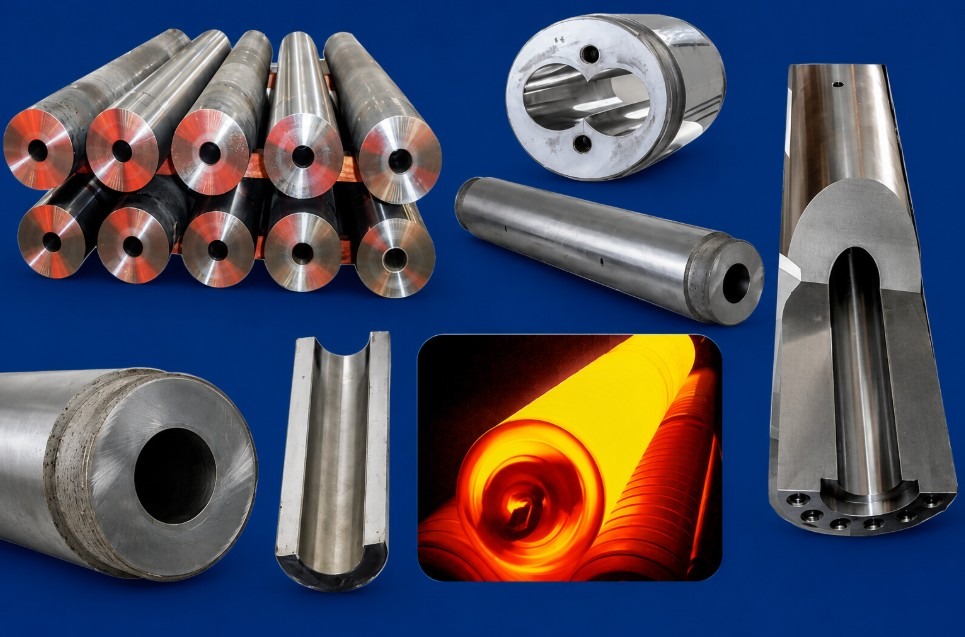
Advanced Bimetallic Barrel Construction
Built as a two-metal system, the bimetallic barrel uses a structural steel outer body for strength and an engineered alloy layer at the working surface. During centrifugal casting, the inner alloy is melted, distributed around the bore, and metallurgically bonded to the base material; the bore is then finish-machined to the required dimensions and surface quality. Product categories include single-screw, parallel twin-screw and conical twin-screw barrels for extrusion, injection molding, blow molding and recycling equipment. Options may include new OEM-replacement barrels, custom builds, relined units, feed sections, vented designs, and application-specific ports. Alloy selection distinguishes standard wear, severe-abrasion, and high-corrosion grades.
Premium Materials and Powerful Product Features
The barrel body is engineered for mechanical strength, while the bore lining may use iron-, nickel-, chromium-, boron-, molybdenum-, or tungsten-carbide-containing alloys, selected for the processed resin and filler level. Precision honing supports the specified bore size, straightness, concentricity, and screw clearance. Standard, premium abrasion-resistant and corrosion-resistant grades are available, with single- or twin-bore geometry and custom lengths. Depending on the selected commercial grade, published barrel ranges include inner diameters from 14 to 400 mm, lengths up to 9,000 mm, lining thickness from 1.0 to 1.5 mm or greater, and room-temperature hardness from 55 to 70 HRC minimum. Actual operating limits must be confirmed for each machine and polymer.
Superior Benefits for Longer Service Life
A correctly specified bimetallic barrel protects the bore where friction, glass fiber, mineral fillers, flame retardants, and corrosive processing gases cause the greatest damage. Better wear control helps preserve screw-to-barrel clearance, supporting repeatable melt quality, shot consistency, throughput, and dimensional stability. The durable lining can extend maintenance intervals and reduce unplanned stoppages, scrap, and premature component replacement. Application-matched metallurgy also prevents buyers from overpaying for unnecessary carbide content or selecting a corrosion-resistant grade that lacks adequate abrasion performance. OEM-compatible dimensions simplify replacement, while custom ports, flanges, and heating provisions support installation. The result is a more reliable plasticizing unit, lower lifecycle disruption, and safer, more predictable production planning.
Proven Performance Across Demanding Industries
Bimetallic barrels are used when conventional barrel surfaces wear too quickly or when process stability is commercially critical. In injection molding, they support repeatable plasticizing for automotive, electrical, packaging, and precision-molded parts. In extrusion, they serve pipe, profile, sheet, film, cable, compounding and pelletizing lines that run continuously and cannot tolerate frequent shutdowns. Recycling operations benefit when contaminants, variable feedstock, and high filler content accelerate abrasion. Premium wear grades suit glass-fiber-, mineral- or pigment-filled compounds, while corrosion-resistant alloys are selected for chemically aggressive polymers and additives. The barrel should be matched to resin family, filler percentage, screw metallurgy, operating temperature, output target, and observed wear pattern—not chosen by industry name alone.
Powerful Wear-Resistant Bimetallic Barrel Specifications
| Parameter | Specification |
|---|---|
| Construction | Steel body with metallurgically bonded alloy lining |
| Manufacturing process | Centrifugal casting |
| Lining material | Iron-chromium, nickel-boron, nickel-cobalt or tungsten-carbide alloy |
| Inside diameter | 14–400 mm |
| Outside diameter | Up to 600 mm |
| Maximum length | Up to 9,000 mm |
| Alloy-layer thickness | 1.0–1.5 mm minimum |
| Bore hardness | 55–70 HRC, alloy-dependent |
| Bore roughness | Ra 0.2–0.8 µm |
| Barrel types | Single, parallel twin and conical twin |
| Applications | Extrusion, injection molding, blow molding and recycling |
| Compatibility | Standard, filled, reinforced, recycled and corrosive polymers |
| Connections | Custom flanges, threads, vents and feed openings |
| Dimensions | OEM drawing or sample-based |
| Customization | Material, bore, length, ports and mounting details |
Why Choose Our Reliable Bimetallic Barrels?
Choose Kaivanya Extrusion when you need a bimetallic barrel specified around your machine, resin, and wear mechanism—not a generic part number. Before publishing this section, insert only documented capabilities: available bore and length range, CNC machining, centrifugal-casting process, material traceability, dimensional inspection, hardness testing, bore-finish reports, OEM drawing review, sample reverse engineering, and final inspection records. Add verified experience, production capacity, warranty terms, lead time, and export support where evidence is available. Clear technical review and responsive after-sales support help buyers select suitable metallurgy, confirm compatibility, and reduce costly ordering errors.
Get a Fast Quote for Your Custom Bimetallic Barrel
Need a custom bimetallic barrel for an extrusion, injection molding, blow molding or recycling line? Share your OEM drawing, barrel sample, machine model, resin, filler percentage, and operating conditions. Contact us today to receive an application-matched material recommendation, dimensional review, production lead time, and commercial offer from Kaivanya Extrusion Technik.