

What Is a Bimetallic Twin Screw and When Is It Required?
A bimetallic twin screw is a matched screw pair engineered for demanding twin-screw extrusion duties where standard surfaces may wear too quickly. It combines a strong structural base with a wear- or corrosion-resistant alloy applied to selected working areas. PVC processors, compounders, masterbatch producers and recyclers consider this upgrade when formulations contain abrasive fillers, fibres, pigments, recycled material or corrosive additives. The main reason to invest is controlled service life: suitable metallurgy and accurate screw geometry can help maintain mixing performance, operating clearance and product consistency for longer under the approved processing conditions.
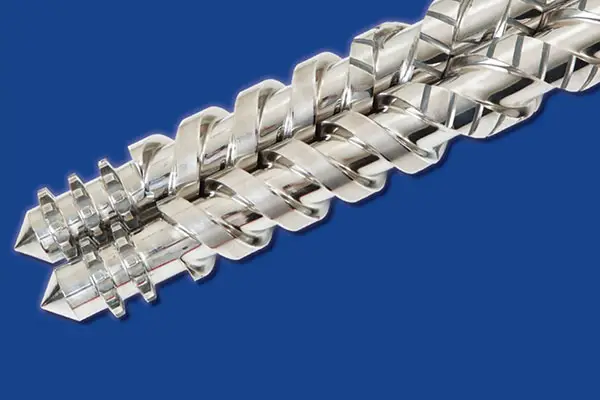
How Bimetallic Twin Screws Are Constructed and How They Work
Each screw is manufactured to operate as part of a coordinated pair inside a compatible twin-screw barrel. The core carries mechanical load, while the working surfaces may receive a manufacturer-qualified hard alloy or protective layer in areas exposed to wear. During operation, the screws convey, compress, mix, and meter material through the barrel while maintaining the designed intermeshing clearance. Available categories include parallel and conical screw pairs, co-rotating or counter-rotating designs, complete screws and replaceable modular elements. Key differences lie in base material, alloy composition, deposition or bonding process, treatment depth, hardness profile, screw geometry, surface finish, straightness, and compatibility with the existing gearbox and barrel.
Key Features of Wear-Resistant Bimetallic Twin Screw Assemblies
A dependable assembly combines a tough base material with application-selected protection on the flights and other high-wear surfaces. Precision machining helps maintain pitch, profile, concentricity, and the required clearance between both screws and the barrel. Options may include localized hardfacing, protected screw tips, replaceable elements, and matching bimetallic barrel liners. Parallel, conical and custom profiles can be produced from approved drawings or verified samples. Performance depends on the processed material, filler level, screw speed, torque, temperature, and melt pressure. For reliable selection, the supplier must confirm alloy compatibility, dimensional tolerances, coating or layer integrity, hardness, usable temperature range, and machine interface through model-specific documentation.
Hardening Process of Twin Screw Set
| Extrusion Heat Treatment | Wear Resistance Bimetallic Screw |
| Gas Nitrided/ Plasma Nitrided | PTA Boron (Full Length) Colomony 56/63 Ni/Cr 1.5mm layer |
| PM Tool steel vacuum hardened | PTA Tungsten 20 to 50 % (Last Zone/Entire) Colomony 88/83/705 |
| Hard Chrome/Tin Plating | HVOF thermal spray coating (88 % Wc 12 cobalt) Flight od and core |
Benefits of Upgrading to a Bimetallic Twin Screw Design
The right bimetallic design can slow dimensional loss in high-wear zones, helping the screw pair retain effective conveying and mixing action for longer. More stable clearances can support consistent output, melt quality, and energy use as operating hours increase. Longer service intervals reduce replacement frequency, unplanned stoppages, and the maintenance effort associated with repeated screw changes. A dimensionally matched replacement also simplifies installation and lowers the risk of alignment problems. When alloy selection reflects the actual resin, fillers, and additives, processors gain better protection against abrasion or corrosion without replacing the complete machine. Consistent geometry also supports safer operation by reducing unexpected mechanical contact and unstable process behaviour.
Bimetallic Twin Screw Applications in PVC, Compounding and Recycling
Bimetallic screw pairs are commonly considered where formulations create sustained abrasive or corrosive wear. A PVC twin screw extruder may need protected flights when processing heavily filled pipe, profile or cable compounds. Masterbatch and engineering-plastic producers use wear-resistant screws for pigments, calcium-carbonate fillers, glass fibre and other demanding additives. Recycling lines may benefit when approved reclaimed feedstock contains variable contamination or abrasive fractions. Parallel twin screws support many compounding duties, while conical twin screws serve selected PVC applications and machine designs. Food-contact or medical processing requires separate alloy, cleanability, and compliance review. In every case, the screw material and surface system must match the actual formulation and barrel construction.
Bimetallic Twin Screw Specifications and Customization Details
| Technical parameter | Specification requirement |
|---|---|
| Product type | Matched bimetallic twin-screw pair |
| Screw configuration | Parallel or conical |
| Screw rotation | Co-rotating or counter-rotating |
| Base material | Approved heat-treated alloy steel |
| Wear-resistant layer | Application-selected bimetallic or hard-alloy protection |
| Protected zones | Flights, tips, mixing sections and other high-wear surfaces |
| Outside diameter | As per approved machine drawing |
| Centre distance | Matched to gearbox and barrel geometry |
| Working and overall length | Customized to the existing extruder |
| L/D ratio | Machine- and application-specific |
| Screw profile | Conveying, compression, kneading, mixing, vented or custom |
| Drive interface | Spline, keyway, coupling or OEM-specific connection |
| Screw pairing | Profile, phase and synchronization checked as a matched set |
| Dimensional control | Straightness, runout, pitch, root diameter and concentricity inspected |
| Operating clearance | Screw-to-screw and screw-to-barrel clearances verified |
| Hardness and layer depth | Confirmed through approved test reports |
| Surface finish | Defined in the drawing and inspection plan |
| Process compatibility | PVC, masterbatch, filled polymers, recycled compounds or approved materials |
| Operating limits | Speed, torque, temperature and melt pressure confirmed for the application |
| Customization | Modular elements, reverse engineering, rebuilding and matching barrel liners |
| Quality documents | Drawing, material certificate, hardness report and dimensional inspection |
How to Choose a Bimetallic Twin Screw Manufacturer in India
Choose a bimetallic twin screw manufacturer that reviews the material recipe, wear pattern, machine model, barrel condition, and existing screw drawing before recommending an alloy. Ask how base material, hardfacing process, heat treatment, and tolerances will be controlled and inspected. A qualified twin screw manufacturer in India should provide drawing approval, material traceability, hardness results, dimensional inspection, and clearly defined acceptance criteria. Compare suppliers on relevant machining capability, alloy application, pair matching, repair assessment, delivery planning, and technical support rather than choosing only the lowest bimetallic twin screw price.
Request a Bimetallic Twin Screw Price and Technical Review
Need a new or replacement screw pair for a PVC, compounding, or recycling extruder? Share the machine model, screw drawing, barrel measurements, material formulation, filler percentage, and wear photographs. Contact Us Today for an application-based metallurgy recommendation, confirmed scope, delivery estimate, and commercial proposal.