

What is An Extrusion Screw Barrel?
extrusion screw barrel is a critical component of a plastic extrusion machine, designed to convey, melt, mix, compress, and homogenize polymer materials before they reach the die. The screw rotates inside a precision-machined barrel while controlled heat and shear transform raw material into a consistent melt. These components are widely required by plastic processors, extrusion machine manufacturers, maintenance teams, machine rebuilders, and production plants. A properly matched screw and barrel can help maintain stable output, improve melt quality, reduce material backflow, and minimize problems caused by excessive wear or incorrect clearance. Custom configurations are available according to machine design, polymer type, production requirements, and operating conditions.
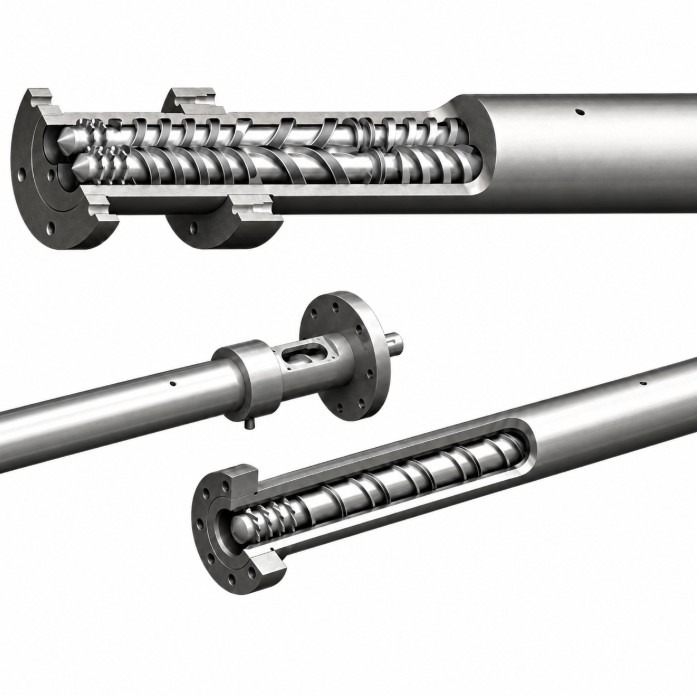
High Quality Extrusion Screw Barrel Product Overview
An extrusion screw barrel consists of a rotating screw installed inside a heated cylindrical barrel. During operation, polymer enters through the feed section and moves through different screw zones, including feeding, compression, mixing, venting, and metering sections. As the material travels forward, heat and mechanical shear gradually convert it into a homogeneous melt suitable for extrusion.
Depending on the machine and application, screw barrel assemblies can be supplied in single-screw, parallel twin-screw, vented, and non-vented configurations. Customers can select an individual screw, barrel, or matched screw-and-barrel set. Application-specific designs can take into account resin type, fillers, output requirements, screw speed, melt pressure, and expected wear conditions.
Powerful Features Built for Extrusion Screw & Barrel
The extrusion screw barrel can be manufactured with material and surface-treatment options selected according to the processing application. Depending on requirements, available options may include nitrided alloy steel, corrosion-resistant materials, wear-resistant construction, hard-facing protection, and bimetallic barrel surfaces.
Precision-machined screw flights and barrel bores help maintain the required operating clearance for consistent plasticizing and material conveyance. Customization can include screw diameter, overall length, L/D ratio, compression ratio, mixing elements, venting sections, drive-end connection, feed opening, heater zones, and thermocouple ports.
Operating limits such as temperature, melt pressure, torque, and rotational speed should be established from the actual machine specifications. This helps ensure compatibility with the intended plastic extrusion machine and polymer-processing conditions.
Our Advance Benefits Of Extrusion Screw Barrels
A correctly designed and matched screw barrel can contribute to smoother feeding, controlled melting, consistent mixing, and stable extrusion output. Maintaining appropriate screw-to-barrel clearance can help control material backflow and support efficient pressure generation.
For processors working with recycled, filled, abrasive, or corrosive polymers, suitable wear-resistant materials and surface treatments can help improve component durability. A replacement manufactured according to approved dimensions can also simplify installation and reduce the need for unnecessary machine modifications.
Consistent melt quality may support better product dimensions, surface finish, color distribution, and process repeatability. More stable extrusion can also help reduce scrap, operator adjustments, material degradation, and unplanned maintenance, supporting more dependable production and potentially lower operating costs.
Applications / Industries
Extrusion screw barrels are used across a wide range of polymer-processing applications where controlled melting and consistent melt delivery are essential. In blown film extrusion, a suitable screw design helps provide stable melt flow for consistent film thickness and quality. Pipe extrusion lines require controlled pressure and output to maintain pipe diameter, wall thickness, and surface finish.
They are also used in extrusion lamination, sheet production, profile extrusion, cable processing, recycling, masterbatch production, compounding, and extrusion blow molding applications. Suitable screw barrel configurations can be developed for polymers such as PVC, PE, HDPE, PP, and other compatible materials.
Plastic processors can also use custom screw barrel assemblies when upgrading equipment, replacing worn components, rebuilding extrusion lines, or matching components to specific production requirements.
Specifications / Technical Details
| Specification | Available Configuration |
|---|---|
| Product Supply | Screw, barrel, or matched screw-and-barrel set |
| Screw Configuration | Single, parallel twin, conical twin, vented, or non-vented |
| Dimensions | Diameter, length, L/D ratio, and clearance according to approved data |
| Screw Profile | Feeding, compression, mixing, venting, and metering zones |
| Construction | Nitrided, wear-resistant, corrosion-resistant, or bimetallic options |
| Connections | Drive end, feed throat, die side, heater zones, and sensor ports |
| Operating Parameters | Temperature, melt pressure, speed, and torque based on machine data |
| Compatibility | Developed using OEM data, approved drawings, samples, or machine details |
| Inspection | Material, dimensional, hardness, and treatment reports when specified |
| Customization | Diameter, L/D ratio, profile, compression ratio, mixing and venting sections |
Why Choose a Specialist Extrusion Screw Barrel Supplier?
Selecting the right supplier is important when replacing or upgrading an extrusion screw barrel. A specialist manufacturer should be able to evaluate application requirements, polymer characteristics, machine data, production targets, and existing wear conditions before finalizing the design.
Buyers comparing extrusion machine manufacturers in India, including suppliers serving Ahmedabad and other industrial regions, should consider manufacturing capability, material traceability, heat-treatment processes, dimensional inspection, drawing approval, testing, delivery support, and technical assistance.
For plastic extrusion machine manufacturers, PVC extrusion machine manufacturers, and processing plants, a supplier capable of producing application-specific components can provide a more suitable solution than a generic replacement part.
Request a Competitive Quote Today
Looking for an extrusion screw barrel for a pipe extrusion line, PVC pipe machine, film extrusion system, compounding unit, or another plastic processing application? Share your machine model, drawing, dimensions, polymer details, output target, and operating conditions. Our team can review the requirements and help determine a suitable screw, barrel, or matched assembly.