

Why Manufacturers Choose a Twin Screw Extruder?
Not every extrusion job is simply about melting plastic. When a formulation contains pigments, fillers, fibres, stabilizers or several feed streams, each ingredient must be introduced and mixed with control. A twin screw extruder gives manufacturers that control through two coordinated screws working inside a carefully zoned barrel. Compounders, PVC processors, recyclers and food producers use this equipment to achieve reliable dispersion, vent unwanted moisture and maintain repeatable product quality. Its real value lies in flexibility: the process can be configured around the recipe instead of forcing every material through one standard setup.
Understanding Twin Screw Extruder Construction and Operating Principles
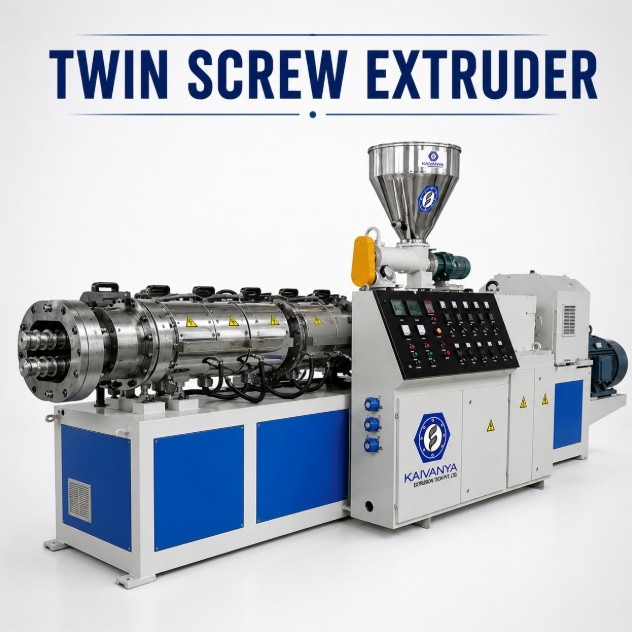
The line combines metering feeders, a drive and gearbox, two intermeshing screws, barrel sections, heating and cooling circuits, vent ports, a die, and downstream handling equipment. As material travels forward, different screw elements convey, compress, knead and blend it. Co-rotating parallel designs are commonly selected for compounding because they provide strong mixing and flexible feed locations. Counter-rotating parallel or conical designs suit particular PVC processing duties. Among the main types of extruder, a single screw extruder is usually preferred for simpler, uniform feedstock, while twin-screw technology handles more complex recipes. Selection depends on torque, screw geometry, free volume, residence time, metallurgy, and feeding accuracy.
Performance Features That Matter in a Twin Screw Extruder Machine
Good performance begins with a stable gearbox, accurate screw alignment, and an extruder screw barrel built for the material’s wear and corrosion behaviour. Modular screw elements allow conveying, mixing and kneading sections to be rearranged as formulations change. Separate barrel zones help operators manage heat at each stage, while vacuum vents remove suitable moisture and volatile content. Depending on the process, the line may include loss-in-weight feeders, side feeding, liquid injection, melt filtration and automatic pelletizing. Nitrided barrels, bimetallic liners or hardened tool-steel elements are application-dependent options. Final limits for screw speed, torque, temperature, melt pressure and output must come from the approved machine specification.
Commercial and Operational Benefits of Twin Screw Extrusion
A well-matched line produces value beyond higher mixing intensity. Accurate dosing reduces formulation drift, and controlled kneading improves colour and additive distribution. Effective venting helps prevent bubbles, odour problems, and moisture-related defects where the process allows it. Because screw elements are modular, production teams can adapt the setup for new recipes without replacing the complete processing section. Monitored torque and temperature provide earlier warning of unstable conditions, supporting planned intervention instead of sudden stoppages. Replaceable wear components can also simplify maintenance budgeting. Together, these advantages improve batch consistency, reduce reject material, protect downstream equipment, and give manufacturers greater confidence when accepting technically demanding customer orders.
Twin Screw Extruder Applications Across Plastics, PVC and Food Processing
Masterbatch producers rely on twin-screw compounding to distribute pigments and additives evenly through carrier resin. Engineering-plastic businesses use it for mineral-filled, reinforced or modified compounds. A purpose-designed PVC extruder machine supports pipe compounds, cable materials and extruded profiles while limiting unnecessary thermal stress. Recycling plants can combine controlled feeding, vacuum degassing, and filtration for appropriate reclaimed polymers. A sanitary food extruder machine serves snack, cereal, pet-food, and textured-protein production when designed for the recipe and cleaning method. Compounded pellets may later feed sheet, extruded panels, filament extruder machine, or other extruded product lines. Every application requires its own screw layout, die, and downstream arrangement.
Twin Screw Extruder Technical Specifications and Buying Requirements
| Technical parameter | Recommended specification requirement |
|---|---|
| Machine configuration | Co-rotating parallel, counter-rotating parallel or conical twin screw |
| Processing materials | PVC, PE, PP, ABS, masterbatch, filled compounds, recycled polymers or recipe-approved food materials |
| Screw diameter | Selected according to material, output and required residence time |
| L/D ratio | Application-specific; defined in the approved machine datasheet |
| Screw speed | Variable-speed operation based on mixing and shear requirements |
| Specific torque | Confirmed according to formulation viscosity and processing load |
| Main drive | AC motor with VFD and high-torque gearbox |
| Screw elements | Modular conveying, kneading, mixing, reverse and sealing elements |
| Screw material | Nitrided steel, tool steel or wear-resistant alloy |
| Barrel construction | Segmented or application-specific barrel with replaceable liners where offered |
| Barrel liner material | Nitrided, bimetallic or hardened wear-resistant material |
| Feeding system | Volumetric, gravimetric, loss-in-weight or force feeding |
| Side feeding | Available for fillers, fibres, powders and additives |
| Liquid dosing | Optional controlled injection for oils, plasticizers or processing aids |
| Heating system | Independently controlled electric barrel-heating zones |
| Cooling system | Water or air cooling according to the machine design |
| Venting | Atmospheric venting, single vacuum or multiple vacuum-degassing sections |
| Process monitoring | Screw speed, motor load, torque, melt temperature and pressure indication |
| Melt filtration | Manual, hydraulic, continuous or backflush screen changer |
| Pelletizing options | Strand, water-ring, hot-face or underwater pelletizing |
| Control system | PLC/HMI with recipes, trends, alarms, interlocks and data-recording options |
| Die connection | Customized flange and die interface for the finished product |
| Utility connections | Electrical supply, cooling water, compressed air, vacuum and process water |
| Operating temperature | Material- and model-specific; confirmed in the approved datasheet |
| Operating pressure | Defined by maximum allowable melt or die pressure; valve-style pressure class is not normally applicable |
| Safety features | Emergency stops, fixed and interlocked guards, overload protection and temperature or pressure alarms |
| Customization | Screw profile, metallurgy, feeding, venting, filtration, controls, die and downstream equipment |
| Documentation | Datasheet, general-arrangement drawing, utility schedule, manuals and acceptance-test procedure |
Selecting a Twin Screw Extruder Manufacturer in Ahmedabad or India
The right extruder machine manufacturer will discuss your material before recommending machine size. Share the recipe, processing difficulty, required capacity, pellet quality, and available utilities, then compare proposals on the same basis. While evaluating extruder manufacturers in India or an extruder machine manufacturer in Ahmedabad, check whether trials, drawings, inspection records, training, commissioning, spares, and warranty are clearly included. A plastic extruder machine manufacturer in India should also explain the proposed screw configuration and wear materials. For PVC, assess each PVC extruder machine manufacturer in India against your actual formulation instead of choosing only by price.
Get Twin Screw Extruder Machine Price and Technical Guidance
Planning a new compounding line or replacing existing equipment? Send your formulation, feed rate, output target, pellet specification, utilities, and layout restrictions for a meaningful extruder machine price. Enquire Now for a suitable configuration, confirmed scope, delivery plan, and commercial offer.