

When a Parallel Co-Rotating Twin Screw Extruder Makes Business Sense
Complex compounds need more than heat and pressure; every ingredient must be introduced, mixed, and vented at the right stage. A parallel co-rotating twin screw extruder gives processors this control through two parallel screws turning in the same direction. It is well suited to masterbatch, filled compounds, reinforced plastics, polymer blends and selected recycling applications. Manufacturers consider this machine when they need dependable dispersion, flexible dosing, and repeatable pellet quality across changing recipes. Because the processing section can be reconfigured, the same line can support product development today and a broader production portfolio tomorrow.
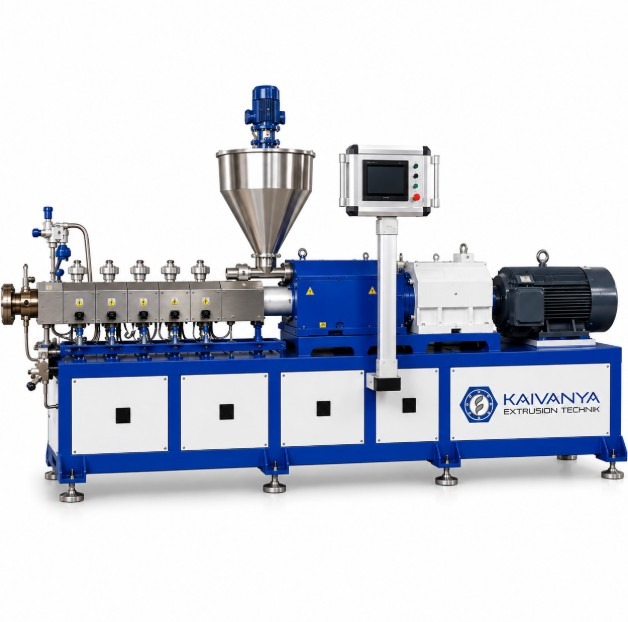
Inside a Parallel Co-Rotating Twin Screw Compounding Line
Two intermeshing screws run side by side inside a modular barrel and receive power through a synchronized gearbox. Main feeders introduce the base polymer, while side feeders and liquid ports add fibres, powders, oils or processing aids at suitable locations. Conveying elements move the material; kneading and mixing elements apply controlled shear and distribute ingredients. Barrel zones heat or cool the process, and atmospheric or vacuum vents remove suitable moisture and volatiles before discharge. Lines may use strand, water-ring, hot-face, or underwater pelletizing according to the compound. Model differences include screw diameter, free volume, L/D ratio, torque, speed, feeder capacity, wear protection, and automation level.
Features That Define a Dependable Co-Rotating Twin Screw Extruder
The machine should combine a rigid frame with a high-torque gearbox, accurately aligned shafts and a modular twin screw and barrel system. Individual conveying, kneading, mixing, and reverse elements let engineers build a screw profile around the formulation. Segmented barrels provide planned locations for feeding, side feeding, liquid dosing, venting and pressure development. Independent heating and cooling zones help manage material temperature along the process. Optional equipment includes loss-in-weight feeders, vacuum systems, melt filtration and automatic pelletizing. Tool-steel screw elements, nitrided barrels or bimetallic liners may be selected for abrasive formulations. Final speed, torque, temperature, pressure and output limits require model-specific confirmation.
How Co-Rotating Twin Screw Technology Adds Production Value
Better control over ingredient location and mixing energy can improve colour consistency, filler dispersion and additive performance. Accurate dosing helps maintain the formulation from batch to batch, while effective venting can reduce moisture and volatile-related defects. Modular screw elements make trials, scale-up work and recipe changes easier to plan because the processing profile can be adjusted. Replaceable wear parts also support targeted maintenance instead of replacing the complete processing section. Torque, pressure and temperature monitoring gives operators useful feedback before a small process variation becomes a shutdown. These advantages can reduce rejects, lower repeat processing, protect pellet quality and help manufacturers serve customers with more demanding compound specifications.
Industries Using Parallel Co-Rotating Twin Screw Extrusion Lines
Colour and additive masterbatch producers use co-rotating equipment to achieve uniform pigment and additive distribution. Filler manufacturers process calcium carbonate, talc and other minerals through carefully selected feeders and screw elements. Engineering-plastic compounders handle glass fibre, impact modifiers, flame retardants and performance additives for automotive, electrical and industrial products. Suitable recycling projects use controlled feeding, filtration and vacuum degassing to improve reclaimed-polymer consistency. Other applications include polymer alloys, biodegradable materials, cable compounds, reactive extrusion and hot-melt formulations. The pellets produced may supply moulding, pipe, profile, sheet, film or filament operations. Each product needs its own wear materials, screw sequence, operating window and pelletizing method.
Technical Information Required for Co-Rotating Extruder Selection
| Technical Parameter | Specification Requirement |
|---|---|
| Machine Type | Parallel intermeshing co-rotating twin screw extruder |
| Processing Duty | Continuous mixing, compounding, devolatilization and pelletizing |
| Screw Arrangement | Two parallel screws rotating in the same direction |
| Screw Construction | Modular elements mounted on splined shafts |
| Screw Diameter | Selected according to formulation and required output |
| Centre Distance | Matched to screw geometry, barrel and gearbox |
| L/D Ratio | Configured according to residence time and processing stages |
| Screw Speed | Variable and model-specific |
| Specific Torque | Selected according to formulation viscosity and processing load |
| Main Drive | AC motor with variable-frequency or approved speed control |
| Gearbox | Synchronized, high-torque gearbox with thrust-bearing arrangement |
| Screw Elements | Conveying, kneading, mixing, reverse, sealing and custom elements |
| Screw Metallurgy | Nitrided steel, tool steel or wear-resistant alloy |
| Barrel Construction | Modular segmented barrel |
| Barrel Sections | Feed, closed, side-feed, vented and discharge sections |
| Barrel Liner | Nitrided, bimetallic or replaceable hardened liner |
| Feeding System | Volumetric, gravimetric or loss-in-weight feeder |
| Side Feeding | Optional feeder for fibres, fillers, powders and additives |
| Liquid Dosing | Optional metered injection for oils, plasticizers or processing aids |
| Heating System | Independently controlled electric barrel-heating zones |
| Cooling System | Water or air cooling according to the approved design |
| Degassing | Atmospheric venting or single/multiple vacuum ports |
| Process Monitoring | Screw speed, torque, motor load, temperature and melt pressure |
| Melt Filtration | Manual, hydraulic, continuous or backflush screen changer |
| Pelletizing Options | Strand, water-ring, hot-face or underwater pelletizing |
| Control System | PLC/HMI with recipes, alarms, trends, interlocks and data logging |
| Utility Connections | Electrical supply, cooling water, compressed air, vacuum and process water |
| Operating Temperature | Material- and model-specific |
| Maximum Melt Pressure | Confirmed by approved machine and die design |
| Pressure Class | Not applicable; specify maximum allowable process pressure |
| Safety Provisions | Guards, emergency stops, overload protection and pressure/temperature alarms |
| Customization | Screw profile, barrel length, metallurgy, feeding, venting and pelletizing |
| Documentation | Datasheet, drawings, utility schedule, manuals and acceptance procedure |
Choosing a Parallel Co-Rotating Twin Screw Extruder Supplier
A useful proposal should begin with your formulation and quality target, not a generic machine chart. Ask the co-rotating twin screw extruder manufacturer to explain the screw layout, torque selection, feeder positions, wear materials, and pelletizing choice. When comparing a parallel twin screw extruder manufacturer in India, request relevant trials, approved drawings, and written acceptance criteria. Confirm the included training, commissioning, spare parts, warranty, and response support. Compare total equipment scope and processing suitability carefully, because the lowest twin screw extruder price may exclude feeders, utilities, controls, or essential downstream equipment.
Get a Parallel Co-Rotating Twin Screw Extruder Proposal
Share your material recipe, feed characteristics, target output, pellet specification, utility availability and floor-space limits. Talk to an Expert for a practical screw configuration, clearly defined equipment scope, confirmed technical requirements, delivery plan, and commercial proposal tailored to your compounding process.