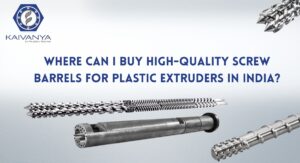


A screw barrel is one of the most important components in plastic processing machinery. It controls how plastic material is fed, melted, mixed, compressed, and delivered to the die, mould, or accumulator head. Because of this, the design and condition of the screw barrel can directly influence production output, melt quality, energy consumption, product consistency, and machine performance.
For manufacturers and processors, choosing the right screw barrel is not simply a matter of matching the diameter. The screw profile, barrel construction, material, operating conditions, polymer type, filler content, and machine configuration all need to work together.
Kaivanya Extrusion Technik is a screw barrel manufacturer in India offering screw and barrel solutions for extrusion, injection moulding, blow moulding, recycling, and compounding applications. Its range includes nitrided, bimetallic, and custom-engineered screw barrel assemblies developed according to machine specifications and processing requirements.
What Is a Screw Barrel and Why Is It Important?
The screw and barrel form the primary plasticizing system inside many plastic processing machines. Raw material enters through the feed opening and is transported along the barrel as the screw rotates. During this movement, the material is gradually compressed, heated, mixed, and converted into a consistent melt.
The quality of this process has a direct effect on the final production result.
A properly designed screw barrel can help achieve stable material feeding, controlled melting, uniform mixing, consistent melt temperature, reliable pressure generation, repeatable output, and improved process stability.
One of the most important factors is the clearance between the screw flights and the barrel bore. If the clearance becomes excessive because of wear, more material can flow backwards instead of moving efficiently toward the discharge end. This may reduce output, affect pressure stability, increase energy consumption, and make the process harder to control.
The screw profile is equally important. An unsuitable profile can result in incomplete melting, poor mixing, excessive melt temperature, material degradation, or inconsistent output.
That is why selecting a replacement screw barrel based only on nominal diameter is not recommended. Machine design, polymer characteristics, filler percentage, production requirements, and the existing wear pattern should all be considered before manufacturing or replacing the component.
Screw Barrel Solutions for Different Plastic Processing Machines
Extrusion Screw Barrel
Extrusion screw barrel continuously transports and plasticizes raw material before delivering the melt through a die. It is widely used in the production of pipes, profiles, films, sheets, cables, pellets, and other continuous plastic products.
The screw geometry should be selected according to the polymer, required output, die pressure, processing temperature, and desired melt quality. Depending on the application, manufacturers may use conventional, barrier, mixing, or vented screw designs.
A properly matched extrusion screw barrel helps maintain consistent plasticization, stable output, controlled melt pressure, and reliable performance during extended production runs.
Injection Moulding Screw Barrel
Injection moulding screw barrel works with a rotating and reciprocating screw. During the recovery stage, the screw rotates to plasticize and prepare a measured shot of molten material. The screw then moves forward to inject the melt into the mould.
The correct screw barrel configuration depends on factors such as screw diameter, shot weight, resin type, filler content, recovery time, injection pressure, and production cycle.
Wear in the screw, barrel, or non-return valve can affect shot consistency and may lead to longer recovery times, inconsistent shot weights, poor filling, and variations in moulded-part quality.
Blow-Moulding Screw Barrel
A blow-moulding screw barrel prepares plastic melt for parison production or an accumulator head. The process requires consistent material flow, stable melt temperature, and dependable output.
The screw design should take into account the polymer’s melt strength, recycled material content, colour-change requirements, machine cycle, and head configuration.
Poor plasticization can contribute to variations in wall thickness, surface appearance, dimensional stability, and finished-product strength.
Recycling Screw Barrel
Plastic recycling equipment often processes regrind, washed flakes, mixed feedstock, and materials that may contain contaminants. These conditions can create higher wear and processing demands than conventional virgin-material applications.
A recycling screw barrel may therefore require enhanced wear resistance, improved feeding, effective mixing, venting capability, and compatibility with filtration systems.
The appropriate design depends on the material form, moisture content, contamination level, recycled content, processing temperature, and required pellet output.
Compounding Screw Barrel
Compounding machines combine polymers with fillers, fibres, pigments, stabilisers, and other functional additives. Twin-screw systems are frequently used because they provide flexibility in conveying, mixing, dispersing, and venting.
For these applications, the screw elements, barrel sections, and wear protection need to be selected according to filler concentration, required dispersion, operating temperature, torque, and production requirements.
A well-designed screw barrel can contribute to better mixing efficiency, stable processing, and more consistent compound quality.
Main Types of Screw Barrels
| Screw Barrel Type | Common Applications | Key Advantage |
|---|---|---|
| Single-Screw Barrel | Pipe, film, sheet, profile and blow moulding | Simple operation and dependable conveying |
| Parallel Twin-Screw Barrel | Extrusion and compounding | Flexible processing and effective mixing |
| Injection Moulding Screw Barrel | Plastic component manufacturing | Controlled shot preparation and repeatable plasticization |
| Bimetallic Screw Barrel | Abrasive and corrosive materials | Enhanced bore protection |
| Nitrided Screw Barrel | General plastic processing | Economical surface hardness and wear protection |
| Custom Screw Barrel | Machine-specific applications | Dimensions and geometry matched to the machine |
Nitrided vs Bimetallic Screw Barrels
Two commonly considered barrel constructions are nitrided and bimetallic screw barrels. The better choice depends on the material being processed and the severity of the operating environment.
What Is a Nitrided Screw Barrel?
A nitrided screw barrel is generally manufactured from suitable alloy steel and subjected to a nitriding treatment. This process creates a hardened surface layer that improves surface hardness, wear resistance, and dimensional stability.
Nitrided barrels are often a practical choice for general plastic processing and applications involving unfilled or moderately demanding materials.
However, the nitrided layer has a limited depth. Once significant wear penetrates beyond the hardened layer, the underlying base material may wear more quickly.
What Is a Bimetallic Screw Barrel?
A bimetallic screw barrel combines a strong steel outer body with a wear-resistant alloy lining inside the barrel bore. The lining can be selected according to the required balance of abrasion resistance, corrosion resistance, service life, and operating cost.
Bimetallic construction is commonly considered for applications involving:
- Glass-filled polymers
- Mineral-filled compounds
- Recycled plastics
- Engineering polymers
- Corrosive formulations
- High-output processing
- Long continuous production cycles
For demanding applications, Kaivanya Extrusion Technik can provide nickel-based, cobalt-based, and tungsten-carbide-based alloy lining options. The barrel lining and screw material should be selected as a compatible working pair to achieve balanced wear performance.
What Technical Details Are Required for a Quote?
| Factor | Nitrided Screw Barrel | Bimetallic Screw Barrel |
|---|---|---|
| Construction | Alloy-steel body with hardened surface | Steel body with wear-resistant alloy lining |
| Wear Resistance | Suitable for moderate applications | Better suited to severe abrasive conditions |
| Corrosion Resistance | Depends on steel and treatment | Can be engineered for stronger protection |
| Typical Materials | Unfilled and lightly filled polymers | Filled, recycled and corrosive materials |
| Initial Cost | Generally more economical | Generally higher |
| Best Suited For | General-purpose processing | Demanding, high-wear applications |
Materials Used for Screw Barrel Manufacturing
Material selection plays an important role in screw barrel performance. It affects hardness, strength, toughness, wear resistance, corrosion resistance, machinability, and service life.
Depending on the application, Kaivanya Extrusion Technik works with materials such as:
- 38CrMoAlA (SACM645)
- EN41B
- 42CrMo
- 34CrAlNi7
- H13
- SKD61
The most suitable material depends on the component design, heat-treatment requirements, polymer being processed, filler content, operating temperature, pressure, speed, and expected production conditions.
For highly abrasive or corrosive applications, an application-specific alloy lining can provide additional protection. Screw flights may also require hardfacing or another suitable wear-resistant treatment.
The goal is not simply to choose the hardest material. The screw and barrel should be engineered together so that the complete plasticizing system delivers reliable performance without creating unnecessary wear on either component.
Custom Screw Barrel Manufacturing
Every plastic processing machine has its own dimensional and operating requirements. Even machines with the same nominal screw diameter may have different lengths, shank designs, splines, flanges, feed openings, heater arrangements, and mounting dimensions.
For this reason, custom screw barrel manufacturing is often the right approach for replacement components, machine upgrades, specialised materials, or discontinued parts.
Before manufacturing, important information may include:
- Machine manufacturer and model
- Processing method
- Screw diameter and effective length
- L/D ratio
- Screw shank and drive connection
- Spline dimensions
- Barrel flange and mounting details
- Feed opening and vent locations
- Polymer type and grade
- Filler and additive percentage
- Required production output or shot weight
- Operating temperature and pressure
- Current wear pattern
- Existing production problems
Based on this information, the screw profile can be developed around the required feeding, melting, mixing, conveying, and pressure-generation characteristics.
Depending on the process, the design may include conventional feed, compression, and metering zones, as well as barrier, mixing, or venting sections.
Where Are Screw Barrels Used?
Pipe and Profile Extrusion
Screw barrels are widely used for PE, PP, PVC, and other materials in pipe, conduit, window-profile, technical-profile, and construction-product manufacturing.
Consistent plasticization and stable output are important for maintaining dimensional accuracy and surface quality.
Film and Sheet Production
Injection moulding, extrusion, and blow moulding machines use screw barrel systems to manufacture bottles, containers, caps, closures, trays, and various packaging products.
Packaging Manufacturing
Injection, extrusion and blow-moulding machines use screw barrels to produce bottles, containers, caps, closures, trays and flexible packaging products.
Automotive Components
Automotive plastic components frequently use engineering polymers containing glass fibres, minerals, flame retardants, and other additives. These materials can create demanding wear conditions, making appropriate metallurgy and wear protection important.
Cable and Wire Coating
Cable extrusion requires controlled material delivery around the conductor. Screw geometry must be matched to the insulation or sheathing compound, required output, melt temperature, and production speed.
Plastic Recycling
Recycling systems rely on screw barrels for conveying, melting, mixing, venting, filtration, and pelletizing recovered plastic. Material variability and contamination can make feeding performance and wear resistance especially important.
Compounding and Masterbatch
Compounding equipment uses screw and barrel systems to combine polymers with pigments, fillers, fibres, and functional additives. Screw configuration and barrel design influence mixing efficiency, dispersion, temperature control, and final compound consistency.
How to Choose the Right Screw Barrel Manufacturer in India?
Look for Technical Understanding
A reliable manufacturer should understand the relationship between the machine, polymer, filler content, operating conditions, screw geometry, and production target.
The manufacturer should ideally review the application before recommending a material or design rather than supplying a generic component based only on diameter.
Check Available Material and Wear Options
Different applications require different levels of protection. A capable manufacturer should be able to provide suitable alloy steels, nitriding treatments, bimetallic options, and wear-resistant alloy systems where required.
Confirm Dimensional Compatibility
Important dimensions include screw diameter, barrel bore, overall length, shank, spline, flange, feed opening, vent positions, and mounting details.
These dimensions should be confirmed using an approved engineering drawing, machine data, or an accurately measured component sample.
Consider the Screw and Barrel as a Pair
The screw and barrel operate together. Choosing an extremely wear-resistant barrel without considering screw material and surface treatment can shift the wear problem to the screw.
A balanced material combination is therefore important for long-term performance.
Choose Custom Manufacturing Capability
Custom manufacturing can be particularly valuable when replacing obsolete components, modifying an existing machine, processing a new material, or addressing a recurring production problem.
Prioritise Clear Technical Communication
Accurate communication can prevent mistakes involving dimensions, material grades, screw profiles, and process requirements.
Before production begins, buyers should provide complete technical information and confirm the final specifications.
Why Choose Kaivanya Extrusion Technik?
Kaivanya Extrusion Technik manufactures screw barrel assemblies for extrusion, injection moulding, blow moulding, recycling, and compounding applications.
The company provides nitrided, bimetallic, and custom-engineered configurations based on machine requirements and the characteristics of the material being processed.
Available material and protection options include nitriding steels, alloy steels, tool steels, and application-specific nickel-, cobalt-, and tungsten-carbide-based alloy linings for demanding processing conditions.
As a screw and barrel manufacturer in India serving domestic and international markets, Kaivanya Extrusion Technik focuses on machine-specific engineering rather than one-size-fits-all solutions.
Drawings, component samples, machine specifications, and processing information can be reviewed to determine suitable dimensions, screw geometry, metallurgy, and wear protection.
This approach helps customers select a screw barrel that is compatible with their equipment and suited to their actual production environment.
What Information Is Needed for a Screw Barrel Quotation?
Providing complete technical information can make the quotation and manufacturing process faster and more accurate.
Ideally, share:
- Machine manufacturer, model, and serial number
- Extrusion, injection moulding, blow moulding, recycling, or compounding process
- Screw and barrel drawing, if available
- Photographs of the existing components
- Screw diameter and overall length
- L/D ratio
- Shank, spline, and drive details
- Barrel flange and mounting dimensions
- Polymer type and grade
- Filler, additive, or recycled-material percentage
- Required output or shot size
- Current processing or wear problem
- Existing material and surface treatment
- Required quantity
- Delivery location
The more complete the technical information, the easier it is to confirm compatibility and recommend an appropriate screw barrel configuration.
Yes. Custom manufacturing can follow an approved drawing or measured sample. Machine details and application data are required to confirm the geometry, mounting, and material.
Request a Custom Screw Barrel Quote
The right screw barrel starts with the right technical information. Whether you need a replacement component, a custom screw barrel, a nitrided barrel, or a bimetallic solution, the machine and processing conditions should be evaluated before finalising the design.
Share your machine model, screw/barrel drawing or sample details, polymer type, filler percentage, required output, and current processing issue with Kaivanya Extrusion Technik.
Contact Kaivanya Extrusion Technik today to discuss your application and request a suitable screw barrel recommendation and detailed quotation for extrusion, injection moulding, blow moulding, recycling, or compounding machinery.