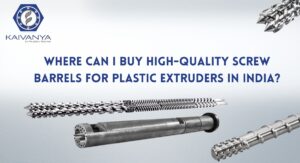


Kaivanya Extrusion Technik screw barrel Manufacturer is the core plasticizing assembly used to melt, mix, and convey material in plastic-processing machinery. It consists of a rotating screw operating inside a precisely machined barrel. Together with heater bands, cooling systems, and temperature controls, the assembly transforms solid resin into a consistent melt ready for extrusion, injection, or blow molding.
Screw barrels are used in pipe, profile, sheet, film, packaging, automotive, cable, recycling, and molded-product manufacturing. Their geometry, material, and surface protection directly influence output, melt quality, energy use, and operating life. This guide explains how screw barrels work, compares the main types and materials, identifies critical specifications, and helps buyers select a reliable replacement or custom screw barrel.
What Is a Screw Barrel and How Does It Work?
A screw and barrel assembly contains a helical screw fitted inside a cylindrical barrel. The screw rotates to move material forward, generate shear, and distribute heat. The barrel contains the processing pressure, supports heating and cooling equipment, and maintains the working clearance around the screw.
In a conventional three-zone screw, processing occurs through the following stages:
- Feeding: Pellets, powder, regrind, or compounds enter through the feed opening. Deep screw channels capture and convey the material forward.
- Compression: Channel volume gradually decreases, compacting the material, removing trapped air, and increasing contact with the heated barrel.
- Melting and mixing: Heat from the barrel and mechanical energy from screw rotation convert the solid material into a melt. Proper geometry promotes thermal and material uniformity.
- Metering: The screw delivers a controlled, homogeneous melt at the pressure and rate required by the machine.
- Discharge or injection: An extruder continuously moves the melt through a die. In injection molding, a reciprocating screw accumulates a measured shot and then moves forward to inject it into the mold.
Twin-screw machines may use configurable zones for conveying, plasticizing, dispersive or distributive mixing, venting, and pressure generation.
Main Types of Screw Barrels: Choose the Right Configuration
Injection Molding Screw Barrel
An injection molding screw barrel uses a reciprocating screw. The screw rotates and retracts while plasticizing a measured quantity of material. It then moves axially to inject the melt through the nozzle and into the mold.
Selection depends on shot weight, screw diameter, recovery time, resin, filler content, and required injection pressure. A worn screw, barrel, or non-return valve can cause inconsistent cushion, unstable shot weight, and longer recovery time.
Extruder Screw Barrel
An extruder screw barrel operates continuously. The rotating screw conveys material from the hopper, melts and mixes it, builds pressure, and delivers a stable flow through a die.
Extrusion screw design is matched to the required product, output rate, polymer, die resistance, and cooling arrangement. Pipe, profile, sheet, film, cable, and pelletizing lines may require significantly different geometries even when their screw diameters are similar.
Single-Screw Barrel
A single-screw barrel uses one rotating screw and is widely selected for stable conveying, melting, and pressure generation. It is commonly used for polyolefins and other thermoplastics in film, pipe, sheet, profile, and blow-molding production.
Single-screw systems offer straightforward operation, comparatively simple maintenance, and efficient continuous processing. General-purpose, barrier, vented, and mixing screw designs are available for different melting and homogenization requirements.
Twin-Screw Barrel
A twin screw barrel contains two rotating screws that may be co-rotating or counter-rotating and intermeshing or non-intermeshing. The configuration is selected according to the feeding, mixing, shear, venting, and pressure requirements.
Co-rotating twin-screw extruders are widely used for compounding polymers with fillers, pigments, additives, and reinforcing materials. They can combine conveying, melting, mixing, devolatilization, and pressure generation in one configurable process section. We describe twin-screw extruders as continuous systems for mixing, melting, dispersing, and compounding polymers, additives, and fillers.
Conical and Parallel Twin-Screw Barrel
Conical twin screws reduce in diameter toward the discharge end, while parallel twin screws maintain a constant diameter. Both configurations are commonly used for PVC dry blend and other applications requiring controlled plasticization.
Conical designs can provide a compact drive arrangement and effective material intake. Parallel systems are often selected for higher-output production. PVC pipe, profile, and sheet manufacturers use both configurations, but the correct choice depends on formulation, output, thermal sensitivity, and machine design. Kaivanya lists single, conical twin, and parallel twin extruders across pipe, profile, and sheet applications.
Blow-Molding Screw Barrel
A blow-molding screw barrel prepares a stable, uniform melt for forming a parison or supplying an accumulator head. The screw design must provide dependable output without damaging the polymer or creating excessive temperature variation.
Material melt strength, color change requirements, regrind content, head design, and production cycle all influence the correct screw geometry. Continuous extrusion blow molding and accumulator-head machines may require different plasticizing capacities.
Screw Barrel Type Comparison
| Screw barrel type | Main applications | Key advantages | Common materials | Typical machines |
|---|---|---|---|---|
| Injection molding | Molded components and packaging | Accurate shot preparation and repeatable plasticizing | PP, PE, ABS, PA, PC, POM, TPE and engineering plastics | Reciprocating-screw injection machines |
| Extruder | Pipe, profile, film, sheet and cable | Stable continuous output and pressure | PE, PP, PVC, PET, PS and elastomers | Continuous extrusion lines |
| Single screw | General extrusion and blow molding | Simple operation, efficient conveying and easier maintenance | Unfilled or lightly filled thermoplastics | Pipe, film, sheet and blow-molding machines |
| Twin screw | Compounding, masterbatch, recycling and reactive processing | Strong mixing, flexible feeding and effective venting | Polymers with fillers, fibers, pigments or additives | Co-rotating and counter-rotating compounders |
| Parallel twin screw | High-output pipe, profile and sheet | Consistent geometry and scalable output | PVC and selected compounds | Parallel twin-screw extruders |
| Blow molding | Bottles, containers and technical hollow parts | Stable parison quality and controlled melt delivery | HDPE, LDPE, PP, PETG and selected engineering resins | Continuous and accumulator-head machines |
Screw Barrel Materials and Surface Treatments for Longer Life
Wear protection should be selected according to abrasion, adhesion, and corrosion. These mechanisms can overlap, and their severity depends on resin corrosivity, viscosity, hardness, and the type and quantity of fillers. Kaivanya wear guidance emphasizes matching the screw and barrel material system to both the polymer and its additives.
Nitrided Screw Barrel
A nitrided screw barrel is manufactured from suitable alloy steel and treated to produce a hard diffusion layer at the surface. Nitriding provides an economical balance of surface hardness, wear resistance, and dimensional stability.
It is commonly used for clean, unfilled or moderately demanding polymers. Because the hardened case has a finite depth, performance declines after significant surface wear exposes the softer supporting material. Nitrided components may not be the best choice for continuous processing of highly abrasive glass- or mineral-filled compounds.
Bimetallic Screw Barrel
A bimetallic barrel combines a strong steel body with a metallurgically bonded wear-resistant lining. Depending on the duty, the lining may use an iron-based chromium-carbide alloy, a corrosion-focused nickel alloy, or a nickel matrix containing tungsten carbide.
Bimetallic barrels are selected for demanding production, abrasive fillers, corrosive materials, recycled feedstock, and extended operating cycles. The screw should receive compatible protection through hardfacing, tool steel, or carbide-based treatment. A hard barrel paired with an unsuitable screw can shift wear from one component to the other.
Hardened Alloy and Tool-Steel Screw
Through-hardened alloy and tool-steel screws provide wear protection throughout a larger section of the material rather than only at the surface. Powder-metallurgy tool steels containing hard carbide phases may be selected for severe abrasive service.
Hardness alone does not determine operating life. Carbide type, distribution, toughness, corrosion resistance, screw geometry, and the mating barrel material are also important. The correct steel must tolerate processing torque and resist cracking as well as wear.
Chromium and Wear-Resistant Coating
Hard-chromium plating can provide a smooth working surface and protection against adhesion or selected corrosive conditions. Its suitability depends on coating quality, thickness, substrate preparation, and the material being processed.
Nickel- and cobalt-based hardfacing alloys are frequently applied to screw flights. Tungsten-carbide-containing protection may be used for highly abrasive fillers, while corrosion-focused alloys are more appropriate for aggressive chemical environments. Coating selection should therefore follow the dominant wear mechanism rather than a simple “harder is better” rule.
Material and Treatment Comparison
| Material or treatment | Abrasion resistance | Corrosion resistance | Best suited for | Important consideration |
|---|---|---|---|---|
| Nitrided steel | Moderate | Moderate | Unfilled and lightly filled polymers | Economical, but the hardened case is limited |
| Standard bimetallic lining | High | Moderate to high | Continuous extrusion and general filled compounds | Match the barrel alloy with the screw protection |
| Tungsten-carbide bimetallic lining | Very high | Grade-dependent | Glass-, mineral- and heavily filled materials | Higher initial cost; confirm corrosion requirements |
| Through-hardened tool steel | High to very high | Grade-dependent | High-wear screws and demanding production | Toughness and corrosion performance vary by grade |
| Hard chromium | Moderate | Moderate to high | Smooth-surface and selected corrosion applications | Thin coatings require correct preparation and use |
| Nickel- or cobalt-based hardfacing | High | High, depending on alloy | Screw flights exposed to wear and corrosion | Alloy must be compatible with the processed material |
Critical Screw Barrel Specifications Buyers Must Check
Screw barrel specifications are application-specific. A drawing, machine manual, or accurately measured sample should be used instead of relying on diameter and length alone.
| Specification | What it means | Why it matters |
|---|---|---|
| Screw diameter | Nominal outside diameter of the screw | Influences capacity, surface speed, torque and machine compatibility |
| L/D ratio | Effective screw length divided by nominal diameter | Affects residence time, melting, mixing and available processing zones |
| Compression ratio | On a conventional screw, the relationship between feed-zone and metering-zone channel depth | Influences compaction, shear, pressure and melting behavior |
| Flight depth | Distance from flight tip to screw root | Controls channel volume, conveying capacity and shear |
| Flight pitch | Axial distance between corresponding points on adjacent flights | Influences material movement, pressure and residence time |
| Screw profile | Arrangement of feed, transition, metering, barrier, mixing or venting sections | Must match the polymer and processing objective |
| Screw-to-barrel clearance | Radial working gap between the screw flight and barrel bore | Excessive clearance increases backflow and reduces processing consistency |
| Output requirement | Required extrusion rate, usually measured by mass per hour | Determines geometry, drive load and downstream compatibility |
| Shot-size requirement | Required injection volume or weight per cycle | Determines screw diameter, stroke and plasticizing-unit size |
| Machine make and model | Original equipment identification | Confirms mounting, drive, nozzle, flange and dimensional compatibility |
How to Select the Right Screw Barrel
Identify the Processing Method
First determine whether the component is required for extrusion, injection molding, or blow molding. These processes use different screw movements, pressure profiles, and output measurements.
Also identify whether the operation is continuous or intermittent and whether the machine uses one screw, parallel screws, conical screws, or modular screw elements.
Match the Design to the Polymer
Provide the exact polymer grade whenever possible. PE, PP, PVC, PET, PA, PC, POM, TPE, and high-temperature engineering polymers have different melting, shear, residence-time, and corrosion requirements.
A “general-purpose” screw may process several materials adequately, but a resin-specific design usually provides better melt quality and process stability when production volume justifies it.
Consider Fillers and Additives
Record filler type, form, and percentage. Glass fiber, calcium carbonate, titanium dioxide, flame retardants, pigments, magnetic powders, and recycled contaminants can accelerate wear.
Fiber orientation and length also matter. A material containing glass fiber may require different protection from an unfilled grade of the same polymer.
Determine Output and Mixing Requirements
For extrusion, specify the required kilograms per hour, screw speed, melt temperature, head pressure, and final product. For injection molding, provide shot weight, plasticizing time, cycle time, back pressure, and required recovery rate.
Identify whether the main objective is higher output, gentler melting, improved color distribution, filler dispersion, degassing, or reduced melt-temperature variation.
Select the Appropriate Wear Protection
Choose the material system based on the dominant problem:
- Use economical nitrided components for moderate service.
- Consider a standard bimetallic barrel for higher wear protection.
- Use carbide-containing systems for severe abrasion.
- Select corrosion-resistant alloys when chemical attack is the principal risk.
- Match the screw treatment with the barrel lining to avoid an unbalanced wear pair.
Confirm Machine Compatibility
Verify drive splines, shank dimensions, rotation direction, flange pattern, feed opening, nozzle or head connection, heater zones, thermocouple holes, and overall length.
Do not order from a machine model alone when different plasticizing units were available for that model. An approved drawing or physical sample provides stronger dimensional confirmation.
Practical Screw Barrel Selection Checklist
- Processing method and machine type
- Machine manufacturer, model and serial number
- Original screw and barrel drawings
- Screw diameter, overall length and effective L/D ratio
- Polymer name and exact commercial grade
- Fillers, additives and recycled-material percentage
- Required output or shot size
- Operating temperature, speed, pressure and cycle
- Current quality or production problem
- Existing wear pattern and measured clearance
- Required screw and barrel material pairing
- Ports, vents, flanges, threads and heater details
- Inspection reports and material certificates required
- Delivery schedule and order quantity
Material-Compatibility Guide
| Material or process condition | Suggested starting configuration | Main selection priority |
|---|---|---|
| Unfilled PE, PP or PS | General-purpose or barrier single screw with nitrided or standard bimetallic barrel | Stable output and economical service |
| ABS, PC, PET, POM or unfilled PA | Polymer-specific screw profile with appropriate wear and corrosion protection | Melt uniformity, drying and temperature control |
| Glass- or mineral-filled polymers | Bimetallic barrel with hardfaced, carbide-protected or tool-steel screw | Strong abrasion resistance |
| Rigid or flexible PVC | PVC-specific single or counter-rotating twin-screw system | Gentle processing, temperature control and corrosion awareness |
| Recycled or variable feedstock | Wear-resistant screw barrel with suitable mixing, venting and filtration | Contaminant tolerance and process stability |
| Masterbatch and filled compounds | Configurable co-rotating twin-screw system | Dispersive and distributive mixing |
| Flame-retardant or corrosive formulations | Corrosion-resistant barrel lining and compatible screw alloy | Protection against chemical attack |
| Heat-sensitive polymers | Low-shear, short-residence design with accurate temperature control | Preventing thermal degradation |
This table is a starting point, not a final engineering specification. The resin supplier’s processing guidance, OEM limits, and actual production conditions must be reviewed before manufacture.
High-Value Applications of Screw Barrels
- Pipes and profiles: Screw barrels provide continuous plasticization and pressure for PE, PP, and PVC pipe, window profile, conduit, and technical-profile production.
- Film and sheet: Stable melting and output help control film thickness, sheet gauge, transparency, and surface quality.
- Packaging: Injection, extrusion, and blow-molding machines use screw barrels to manufacture caps, closures, bottles, containers, trays, and flexible packaging products.
- Automotive components: Engineering polymers and reinforced compounds require accurate melting and wear-resistant components for consistent mechanical properties.
- Cable insulation: Screw barrels process insulation and sheathing compounds while maintaining controlled output around conductors.
- Recycling and compounding: Wear-resistant systems handle regrind, fillers, pigments, and variable feedstock. Twin-screw extruders are frequently used when mixing, venting, or additive distribution is critical.
- Household and industrial products: Injection molding screw barrels prepare material for appliances, storage products, electrical parts, fittings, and general technical components.
Common Screw Barrel Problems, Causes and Solutions
| Problem | Common symptoms | Likely causes | Corrective actions |
|---|---|---|---|
| Abrasive wear | Lower output, increasing rpm, unstable pressure, oversized parts or worn flights | Glass fiber, minerals, pigments, contamination, unsuitable metallurgy or misalignment | Measure screw and bore wear, inspect alignment, remove contaminants and select compatible wear-resistant materials |
| Corrosion | Pitting, rough surfaces, discoloration, leakage or rapid local wear | Corrosive polymer by-products, moisture, overheating, additives or unsuitable alloy | Verify drying and temperature control, identify the chemical source and use corrosion-resistant metallurgy |
| Uneven plasticization | Unmelted particles, gels, color streaks, inconsistent pressure or variable part quality | Incorrect temperature profile, damaged heaters, excessive output, unsuitable geometry, material moisture or wear | Check heaters and sensors, verify resin preparation, compare settings with the processing window and inspect screw geometry and clearance |
| Reduced output | Lower kilograms per hour, longer recovery time or increased drive load | Excessive clearance, feed starvation, blocked screen, screw wear, temperature problems or downstream restriction | Isolate feeding, plasticizing and downstream causes; inspect screens, controls, screw and barrel dimensions |
| Excessive melt temperature | Discoloration, odor, degradation, high amperage or poor physical properties | Excessive screw speed, back pressure, restriction, residence time, shear or inaccurate sensors | Confirm actual melt temperature, inspect sensors and restrictions, then optimize settings within the resin supplier’s limits |
| Leakage or contamination | Material around joints, black specks, foreign particles or recurring color contamination | Loose or damaged connections, worn sealing surfaces, degraded polymer, dead spots or incorrect purging | Stop unsafe leakage, inspect connections, use an approved purge procedure and repair damaged surfaces before restarting |
Increasing screw-to-barrel clearance is a measurable sign of wear. ENGEL notes that an excessive gap can create process fluctuations and part-quality problems, making periodic condition monitoring valuable for maintenance planning.
Essential Screw Barrel Maintenance Tips
- Follow safe shutdown procedures. Isolate electrical, hydraulic, and mechanical energy before inspection or disassembly. Release material pressure and follow the machine manufacturer’s lockout procedure.
- Avoid cold starts. Allow the barrel and retained material to reach the required temperature before rotating the screw. Starting against solid material can overload the drive and damage the screw, barrel, or instrumentation.
- Control barrel temperatures. Check heater bands, cooling circuits, thermocouples, and controllers. A displayed temperature does not always confirm the actual melt temperature or correct heater operation.
- Use an approved purging procedure. Match the purging compound and temperature range to the production resin and equipment. Avoid unapproved abrasive cleaning materials that may damage critical surfaces. Proper shutdown purging also helps reduce degraded residue and black specks. Why? Material left hot in a barrel can oxidize and form carbon.
- Measure and trend wear. Record screw outside diameter, barrel inside diameter, and calculated clearance at consistent measurement positions. Trends are more useful than waiting for severe quality loss.
- Inspect alignment and support components. Misalignment, worn bearings, damaged thrust components, or incorrect assembly can create uneven metal contact and localized wear.
- Prevent metal contamination. Maintain hopper magnets, screens, and material-handling equipment. Investigate metallic particles immediately because they can damage the screw, barrel, valve, and downstream tooling.
When Should a Screw Barrel Be Repaired or Replaced?
Warning signs include:
- Declining production capacity
- Increasing screw speed needed to maintain output.
- Longer injection recovery time
- Unstable pressure or shot weight
- Poor melt or product consistency
- Excessive screw-to-barrel clearance
- Visible scoring, pitting, or corrosion
- Worn, chipped, or cracked flights
- Material leakage or recurring metal contamination
Repair Versus Replacement
| Consideration | Repair or rebuild may be suitable | Replacement is generally safer |
|---|---|---|
| Damage extent | Wear is measurable but localized | Damage is severe, widespread or structural |
| Screw condition | Core is straight and crack-free with enough material for rebuilding | Screw is cracked, twisted, deeply corroded or repeatedly rebuilt |
| Barrel condition | Bore can be relined or refinished to an approved specification | Barrel body, ports or mounting areas are damaged beyond safe restoration |
| Required performance | Original geometry remains suitable | New polymer, output or process requires redesigned geometry |
| Economics | Rebuild cost and lead time provide a clear lifecycle advantage | Repair approaches the cost of a more suitable new assembly |
| Verification | Qualified supplier can inspect and certify restored dimensions | Required tolerances or material integrity cannot be confirmed |
Qualified suppliers may restore screws through flight rebuilding and precision finishing or rebuild barrels through relining, depending on condition. Kaivanya parts and rebuild program demonstrates that both new and rebuilt screw-and-barrel options are commercially available. Final suitability should follow dimensional inspection and, where necessary, crack testing and material evaluation.
Screw Barrel Price Factors
A screw barrel price cannot be determined accurately from diameter alone. Commercial cost depends on:
- Screw diameter and overall length
- Single, parallel-twin or conical-twin configuration
- Base steel and alloy grade
- Nitriding, bimetallic lining, hardfacing or carbide protection
- Screw geometry and mixing features
- Machining complexity and dimensional tolerances
- Feed openings, vents, flanges, threads and sensor ports
- Material certification and inspection requirements
- OEM replacement or custom reverse engineering
- Repair, relining, or completely new manufacture
- Order quantity, packaging, freight and delivery schedule
Buyers should compare material specifications, inspection scope, warranty, and expected operating suitability—not only the initial quotation value.
Information Needed for a Screw Barrel Quotation
For an accurate technical recommendation and quotation, provide:
- Machine manufacturer, model, and serial number
- Extrusion, injection molding, or blow-molding process
- Screw and barrel drawing, if available
- Clear photographs of the complete assembly and damaged areas
- Screw diameter, overall length, and L/D ratio
- Shank, spline, keyway, flange, and connection dimensions
- Polymer name and commercial grade
- Filler, fiber, pigment, additive, and recycled-material percentage
- Required extrusion output or injection shot size
- Current screw speed, temperature, and pressure range
- Existing component material or surface treatment
- Current production, wear, or quality problem
- Required quantity and delivery destination
An existing sample can support reverse engineering, but critical dimensions and application requirements should still be confirmed before production.
Frequently Asked Questions About Screw Barrels
What is the function of a screw barrel?
A screw barrel feeds, melts, mixes, and conveys plastic material. The rotating screw supplies mechanical energy and forward movement, while the barrel contains the material, supports heating and cooling, and maintains processing pressure. In extrusion, it delivers a continuous melt; in injection molding, it prepares and injects a controlled shot.
What is the difference between nitrided and bimetallic screw barrels?
A nitrided barrel has a hardened diffusion layer produced at its bore surface. It is economical for moderate operating conditions. A bimetallic barrel contains a metallurgically bonded alloy lining and is generally selected when stronger abrasion or corrosion protection is required. The correct choice depends on polymer, filler content, and production duty.
How long does a screw barrel last?
There is no universal service-life figure. Operating life depends on material abrasiveness, corrosion, temperature, screw speed, output, alignment, contamination, maintenance, and component metallurgy. Tracking clearance, output, recovery time, and product consistency provides a more reliable replacement indicator than operating hours alone.
What causes premature screw barrel wear?
Common causes include glass or mineral fillers, metallic contamination, corrosive additives, degraded polymer, unsuitable material pairing, excessive temperature, misalignment, cold starts, and operation outside the intended output range. Abrasion, adhesion, and corrosion often act together.
How is the correct L/D ratio selected?
The L/D ratio is selected according to the polymer, processing method, output, melting requirement, mixing requirement, venting needs, and acceptable residence time. A longer screw provides more processing length, but it can also increase residence time and thermal exposure. The complete screw profile matters more than the ratio alone.
Can a worn screw barrel be repaired?
Some worn screws can be rebuilt through flight restoration and finish grinding, while suitable barrels may be relined or refinished. Repair depends on remaining wall thickness, straightness, cracking, corrosion, and the ability to restore the required dimensions. Severely damaged or structurally compromised components should be replaced.
How do I order a replacement screw barrel?
Provide the machine make and model, OEM drawing or sample, material details, output or shot requirement, screw diameter, L/D ratio, and current operating problem. Confirm all mounting, drive, and connection dimensions before approving manufacture. An application review should also determine the appropriate steel and surface protection.
Build a More Reliable Plasticizing Process
Selecting the right screw barrel requires more than matching its diameter. Processing method, polymer, fillers, geometry, output, machine interface, and wear protection must work as one system. Accurate application data helps prevent premature wear, unstable output, and costly replacement errors.
Need a replacement or custom screw barrel? Contact us Today your machine model, material, dimensions, and production requirements for a technical recommendation and quotation.