
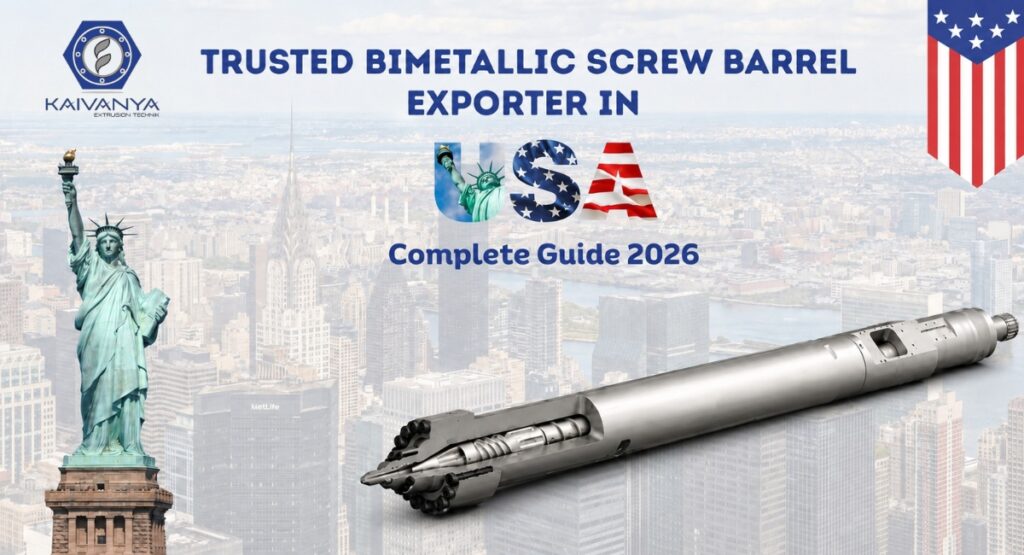
If you need a Bimetallic Screw Barrel Exporter in the USA, the right partner should do more than ship a metal component. A bimetallic screw barrel conveys, melts, mixes, and pressurizes plastic inside injection molding, extrusion, and blow molding machines. It is designed for processors facing wear from glass fiber, mineral fillers, recycled resin, or corrosive additives. Buyers choose this construction because an application-matched alloy protects the main wear surfaces. The result can be more stable processing and fewer emergency replacements, provided the design, materials, dimensions, and operating limits match the machine and resin.
How Does a Bimetallic Screw Barrel Work?
A bimetallic unit uses two material systems to balance structural strength with surface protection. The barrel normally has a strong steel body and an alloy lining along the internal bore. The screw may use hard-facing on the flight lands or other areas exposed to wear. During production, the rotating screw carries resin forward while heat, compression, and shear create a workable melt. Injection screws also move forward to inject each measured shot. Product options include injection molding screws and barrels, single-screw extrusion sets, blow molding components, and parallel or conical twin-screw parts. The real differences are alloy selection, screw geometry, bonding quality, finished clearance, machine fit, and documented inspection.
Which Features Should USA Buyers Verify?
Choose features that match the actual processing problem. The technical offer should name the base steel, liner or hard-facing alloy, protected area, hardness requirement, surface finish, and dimensional tolerances. It should also show screw diameter, effective length, L/D ratio, flight design, mixing sections, drive connection, and rotation direction. Barrel details should cover the feed opening, heater layout, thermocouple ports, cooling zones, flange, nozzle, or die-end connection. Standard and custom sizes may be available, but every dimension must be checked against an approved drawing for compatibility. Temperature, pressure, speed, and torque ratings are machine-specific and must be verified before manufacture rather than copied from a generic catalogue.
What Benefits Does Bimetallic Construction Provide?
Correct alloy selection provides stronger protection where abrasive fillers or corrosive compounds contact the component. Documented material grades support that claim and help buyers compare quotations. Accurate screw geometry and controlled clearance promote steady material movement, mixing, and melt preparation. Inspection of bore size, screw diameter, straightness, and concentricity provides evidence that critical dimensions were checked. Matching drive ends, mounting points, heaters, sensors, and discharge connections can make replacement easier and reduce installation changes. Planned inspection also helps maintenance teams identify wear before it causes a production emergency. Actual service life still depends on resin formulation, alignment, cleaning, machine settings, output demands, and operating practices.
Where Are Bimetallic Screw Barrels Used?
Bimetallic screw barrels are selected for plastic processing lines where ordinary wear surfaces may not provide enough protection. Injection molders use them for automotive components, packaging, electrical parts, appliances, medical products, and consumer goods that require repeatable melt preparation. Extrusion lines use them for pipe, profile, sheet, film, cable coating, and pellet production. Blow molding machines need stable plasticizing for bottles, containers, and larger hollow products. Compounders and recycling plants may process glass-filled polymers, mineral fillers, pigments, regrind, or mixed feedstock. The buyer’s need determines the solution: abrasive compounds need wear-focused alloys, while chemically aggressive materials require compatible corrosion protection and carefully controlled processing conditions.
What Technical Details Are Required for a Quote?
| Technical Parameter | Specification / Details |
|---|---|
| Product Type | Bimetallic Screw Barrel |
| Construction | Steel body with wear- and corrosion-resistant bimetallic alloy lining |
| Barrel Configuration | Single screw, parallel twin screw |
| Screw Diameter | Machine and application specific |
| Base Material | 38CrMoAlA, EN41B, 42CrMo, H13 / SKD61, or application-specific alloy steel |
| Bimetallic Lining | Tungsten carbide, nickel-based, cobalt-based, Colmonoy, or application-specific alloy |
| Layer Thickness | Application and barrel design dependent |
| Bore Hardness | Typically up to 62–68 HRC, depending on alloy and treatment |
| Bore Surface Finish | Precision-machined according to approved drawing and application requirements |
| Cooling System | Air cooling or water cooling, as required |
| Heating System | Band, cast, or cartridge heaters with application-specific heating zones |
| Applications | Plastic extrusion, injection molding, recycling, compounding, film, pipe, sheet, and profile processing |
| Material Compatibility | PE, PP, PVC, ABS, PET, PA, PC, filled, reinforced, recycled, and corrosive polymers |
| Customization | Bore size, length, liner alloy, ports, flanges, cooling, heating zones, and machine interfaces |
| Quality Inspection | Bore dimensions, hardness, surface finish, concentricity, clearances, and dimensional accuracy |
How to Compare Bimetallic Screw Barrel Exporters
Compare suppliers on technical control, not promotional claims. A responsible exporter should review the machine, drawing or sample, processed resin, filler loading, current wear, production target, and operating conditions before confirming a design. Request an approval drawing, material records, dimensional report, and hardness results when hardness is specified. For a USA shipment, confirm price currency, Incoterm, packaging method, freight responsibility, customs documents, delivery point, and lead time. Ask who provides support if the component does not fit or the wear pattern returns. Only use claims about manufacturing capacity, certifications, testing, experience, or delivery performance when the supplier can provide evidence.
Request a Custom Bimetallic Screw Barrel Quote
Ready to compare custom options? Send your machine model, drawing, dimensions, polymer, additives, and wear details to a Bimetallic Screw Barrel Exporter in the USA. Request a technical review and clear quotation covering materials, inspection, export terms, and delivery. Get product details enquire now to start your replacement project.