

What is an Extrusion Screw Barrel?
Unstable output, uneven melting, excessive scrap, and frequent process adjustments can reduce extrusion-line productivity. A correctly matched extrusion screw barrel conveys, melts, mixes, compresses, and meters polymer before it reaches the die. It is used by pipe, profile, film, sheet, cable, compounding, pelletizing, and recycling processors that need consistent melt delivery.
The strongest result comes from matching the screw geometry, barrel construction, working clearance, and surface protection to the polymer, additives, machine, and output target. Share your application details to evaluate a standard replacement or a fully customized assembly.
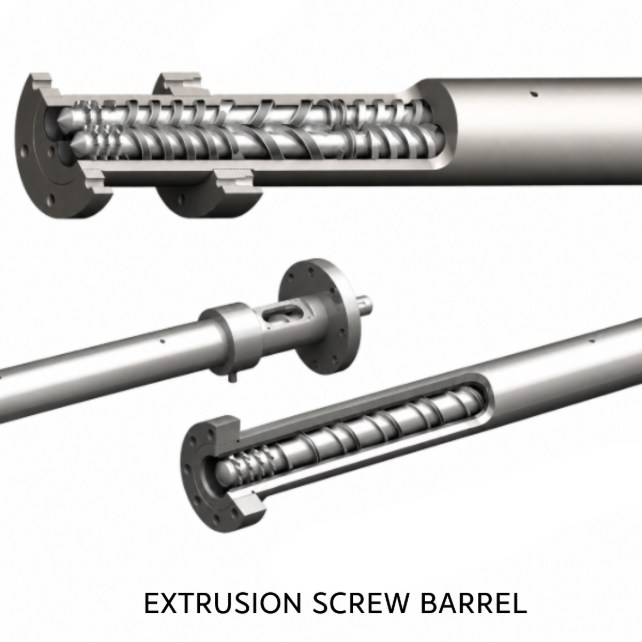
How an Extrusion Screw and Barrel Produces a Uniform Polymer Melt
An extruder screw rotates inside a close-fitting, precision-machined barrel. Raw material enters through the feed opening and moves forward through the screw’s functional zones. Controlled barrel heating and mechanical shear gradually soften and melt the polymer. The screw then mixes and meters the material toward the screen pack and dies at the flow required by the process.
Available configurations can include single-screw, parallel twin-screw, and conical twin-screw assemblies. Barrier, mixing, vented, and application-specific profiles may also be considered. The right configuration depends on resin behaviour, additives, feed form, required output, venting needs, die resistance, and the machine’s drive capability—not on screw diameter alone.
Custom Extrusion Screw Barrel Features and Material Options
- Application-matched screw geometry: Pitch, channel depth, compression, mixing, venting, and metering sections can be selected around the material and finished product.
- Purpose-selected base material: Options from the supplied product range include 38CrMoAlA, SACM645, EN41B, 42CrMo, 34CrAlNi7, H13, and SKD61, subject to manufacturer confirmation.
- Wear and corrosion protection: Nitriding, hardening, bimetallic lining, or application-specific hardfacing may be considered according to abrasion, corrosion, and processing conditions.
- Custom machine interfaces: Feed openings, flanges, bolt patterns, drive ends, discharge ends, heater zones, cooling channels, and sensor ports can be produced from approved data.
- Controlled fit: Screw outside diameter, barrel bore, straightness, concentricity, and working clearance should be inspected against the approved drawing.
- Single and twin-screw compatibility: Designs can be developed for qualifying extrusion, recycling, and compounding equipment.
Benefits of a Precision-Matched Extrusion Screw Barrel
A precision-matched assembly supports more uniform melting, controlled mixing, and steady material delivery. This helps operators maintain repeatable output, product dimensions, colour distribution, and surface quality when the complete process is correctly set.
Suitable geometry can reduce surging, unmelted material, overheating, and avoidable scrap. Appropriate wear protection can also extend service intervals when processing filled, reinforced, recycled, or corrosive compounds. Accurate replacement dimensions reduce the risk of unexpected modifications during installation, while documented operating limits support safer commissioning.
The practical benefit is greater process predictability: fewer corrective adjustments, better use of production time, and a clearer maintenance plan. Actual improvement depends on the machine condition, raw material, tooling, controls, and approved component specification.
Extrusion Screw Barrel Applications Across Plastic Industries
| Application | Customer requirement | Important design considerations |
|---|---|---|
| Pipe, tube, and profile extrusion | Stable dimensions, wall thickness, and surface finish | Resin behaviour, output stability, die resistance, and cooling |
| Film and sheet processing | Uniform melt and consistent gauge | Mixing quality, temperature control, and steady metering |
| Wire and cable coating | Repeatable insulation or sheathing | Controlled flow, material sensitivity, and finish quality |
| Plastic recycling and pelletizing | Reliable processing of variable feedstock | Venting, mixing, contamination, moisture, and wear resistance |
| Masterbatch and compounding | Even distribution of pigments, fillers, fibres, and additives | Dispersive and distributive mixing, torque, and abrasion |
| Specialized extrusion | Process-specific melt preparation | Custom geometry, metallurgy, interfaces, and operating window |
Commonly processed materials may include PVC, CPVC, UPVC, PE, PP, PET, ABS, nylon, TPU, masterbatch, filled polymers, and compatible recycled compounds. Material suitability must be confirmed for the proposed screw design and metallurgy.
Extrusion Screw Barrel Specifications and Customization Options
| Specification | Indicative or customizable option† |
|---|---|
| Product type | Extrusion screw and barrel assembly |
| Configuration | Single screw, parallel twin screw, or conical twin screw |
| Screw diameter | 20 mm–300 mm† |
| L/D ratio | Approximately 18:1–40:1† |
| Base-material options | 38CrMoAlA, SACM645, EN41B, 42CrMo, 34CrAlNi7, H13, or SKD61† |
| Internal-alloy options | Tungsten-carbide, nickel-based, cobalt-based, or Colmonoy-type systems† |
| Bimetallic layer thickness | Approximately 1.5–3 mm† |
| Surface hardness | Approximately 62–68 HRC for applicable alloy or treatment systems† |
| Surface treatment | Nitriding, hardening, bimetallic protection, or application-specific treatment† |
| Custom details | Screw geometry, feed opening, flange, drive end, heater zones, cooling, sensor ports, and discharge interface |
| Operating temperature and melt pressure | Defined for the polymer, geometry, machine, controls, and die; no universal value applies |
| Drive or actuation | The extruder motor and gearbox rotate the screw; the assembly has no independent actuation |
| Compatibility verification | Approved drawing, measured sample, machine data, and operating information |
† These figures are retained from the supplied draft as indicative options, not universal industry standards. Publish them only after confirming that they match the manufacturer’s documented capability. Final dimensions, metallurgy, tolerances, hardness, and treatment must appear on the approved technical specification.
How to Select the Right Screw Barrel for Your Extrusion Machine
Start with the material and production problem. Heat-sensitive polymers may need controlled shear and residence time, while filled or recycled compounds may require stronger wear protection, improved mixing, or venting. Next, define the finished product, current and target output, screw speed, temperature profile, melt pressure, motor load, and recurring quality issues.
Machine compatibility is equally important. Confirm the screw diameter, working and overall length, L/D ratio, barrel bore, drive-end connection, flange, feed opening, heater arrangement, cooling, and discharge interface. When an original drawing is unavailable, a measured component sample and verified machine data can support reverse engineering. Approve the final drawing before manufacturing begins.
What to Verify Before Choosing an Extrusion Screw Barrel Manufacturer
A dependable extrusion screw barrel manufacturer should review application data before recommending a material or design. Ask how the supplier verifies raw material, machining dimensions, heat or surface treatment, straightness, barrel bore, screw profile, hardness, and final working clearance.
Also confirm which inspection records, material certificates, hardness reports, dimensional reports, warranty terms, delivery commitments, installation guidance, and after-sales support are actually included. If the supplier claims particular experience, export coverage, standards, or industries served, request supporting evidence.
Request a Quote for a Custom Extrusion Screw Barrel
Need a replacement or custom extrusion screw barrel for your processing line? Share your machine model, polymer, additives, dimensions, drawing or sample details, output target, and current production issue. Contact us Today for review and receive a clearly defined solution based on your approved application requirements.