

What Is a Single Screw Extruder Machine and Who Should Use It?
A single screw extruder is a continuous-processing machine that conveys, melts, mixes, and shapes a compatible raw material through a precision die. Plastic processors use it to manufacture pipes, tubing, sheet, film, cable coating, profiles, and 3D-printing filament with consistent dimensions. The equipment is suited to businesses processing stable, comparatively uniform formulations that do not require the intensive mixing of a twin-screw system. Buyers should consider this extruder machine for its straightforward construction, efficient operation, easier maintenance, and dependable output when the extruder screw, drive, barrel, and die are correctly matched to the application.
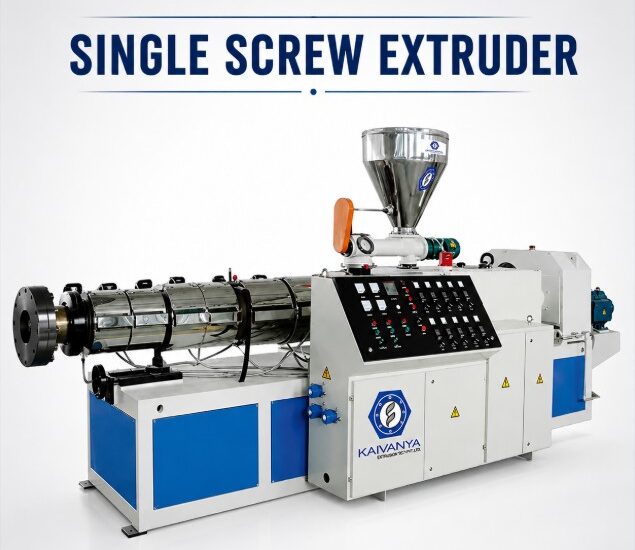
How a Single Screw Plastic Extruder Machine Works and Available Variants
A single screw plastic extruder includes a material feeder, motor, gearbox, heated and cooled barrel, rotating screw, filtration arrangement, die, control panel and application-specific downstream equipment. Raw material enters the feed zone before the screw conveys, compresses, melts, and meters it toward the die. Unlike a twin-screw extruder, this configuration uses one rotating screw and is generally preferred for stable conveying and shaping of consistent feedstock. Variants may be configured as a PVC extruder machine, pipe or profile line, sheet extruder, recycling extruder, or filament extruder. Key differentiators include screw geometry, L/D ratio, metallurgy, drive efficiency, process control, and downstream integration.
Key Features of a High-Performance Single Screw Extruder Machine
A high-quality machine uses a rigid frame, accurately aligned drive system, and a wear-resistant extruder screw barrel assembly selected for the processed material. Multiple heating and cooling zones support controlled barrel temperatures, while melt-pressure and temperature monitoring help protect the process. Screw diameter, L/D ratio, motor power, and output are available in model-specific sizes rather than one universal configuration. Options can include automatic feeding, gravimetric dosing, vacuum venting, screen changers, PLC/HMI controls, and compatible haul-off, cooling, and cutting units. Nitrided or bimetallic screw and barrel surfaces may be specified for abrasive or corrosive formulations, subject to application review and verified manufacturer data.
Production Benefits of Choosing the Right Single Screw Extruder
Correct machine selection helps maintain uniform melt flow, product dimensions, and surface quality across longer production runs. Its comparatively simple mechanical layout can make operation, cleaning and routine maintenance easier, reducing avoidable downtime. Proper screw geometry and zoned temperature control improve material stability, energy use and output consistency while helping limit scrap. Accessible service points and correctly selected wear materials can extend screw and barrel life. Integrated alarms, guarding and interlocks support safer operation when installed, used and maintained correctly. A well-matched line also simplifies downstream coordination, improves repeatability during product changeovers, and gives manufacturers a practical foundation for future automation or production-capacity expansion.
Industrial Applications of Single Screw Extruders for Pipes, Profiles and Filament
Single-screw extrusion serves manufacturers that need continuous, repeatable extruded products from compatible formulations. Typical requirements include PE or PP pipes, flexible tubing, cable insulation, sheet, film, seals, and extruded profiles. A properly engineered PVC extruder machine may process selected PVC applications after formulation and screw-design review. A filament extruder machine helps 3D-printing material producers control filament diameter and winding consistency, while dedicated lines can support extruded panels or extruded polystyrene products. Specialized single-screw systems may also be used as a food extruder machine, but food-contact materials, hygienic construction, cleaning, and recipe performance must be evaluated separately from conventional plastic-processing equipment.
Single Screw Extruder Specifications, Screw Design and Technical Details
| Technical Parameter | Available Configuration / Selection Requirement |
|---|---|
| Machine Configuration | Horizontal, continuous single-screw extrusion system |
| Process Materials | PE, PP, PS, ABS, TPE, selected PVC formulations and other trial-approved thermoplastics |
| Screw Design | General-purpose, barrier, mixing, vented or product-specific geometry |
| Screw and Barrel Metallurgy | Nitrided alloy steel or bimetallic construction, selected for wear and corrosion resistance |
| Screw Diameter and L/D Ratio | Selected according to resin, output, residence time and mixing requirements |
| Main Drive | AC motor with variable-frequency drive, or application-specific alternative |
| Feeding System | Gravity hopper, volumetric feeder, gravimetric dosing or force feeding where required |
| Barrel Temperature Control | Independently controlled heating zones with forced-air or water cooling, as designed |
| Venting and Degassing | Solid barrel, atmospheric vent or vacuum degassing configuration |
| Melt Filtration | Manual, hydraulic or continuous screen-changing system, depending on contamination and uptime targets |
| Process Monitoring | Screw speed, motor load, zone temperature and melt-pressure indication with configurable alarms |
| Die Compatibility | Pipe, tubing, profile, sheet, strand, coating or filament die designed for the finished product |
| Downstream Interface | Cooling tank, calibration table, haul-off, cutter, winder, pelletizer or filament handling equipment |
| Utilities and Connections | Model-specific electrical supply, cooling water, compressed air and vacuum connections |
| Controls | PID controllers or PLC/HMI controls with recipe, trend, alarm and interlock options |
| Operating Pressure | Defined by maximum allowable melt or die pressure; valve-style pressure class is not normally used |
| Safety Provisions | Fixed and interlocked guards, emergency stops, overload protection and temperature or pressure alarms as specified |
| Standards and Documentation | Applicable machinery, electrical and customer requirements; drawings, manuals and test records as contracted |
| Customization Options | Screw profile, metallurgy, feeding, venting, controls, die, screen changer and downstream equipment |
How to Select a Single Screw Extruder Machine Manufacturer in Ahmedabad, India
Choose an extruder machine manufacturer that reviews your raw material, product drawing, output target, tolerances, utilities, and operating conditions before proposing a model. When comparing extruder manufacturers in India, including an extruder machine manufacturer in Ahmedabad or a plastic extruder machine manufacturer in India, request application-relevant references and written acceptance criteria. A capable supplier should provide transparent specifications, documented inspections, trial procedures, operator guidance, spare-parts availability, warranty terms, and technical-support commitments. Verify manufacturing capability, testing scope, delivery schedule, and service coverage instead of relying only on brochure claims.
Get Single Screw Extruder Machine Price and Request a Custom Quote
To receive an accurate extruder machine price, share your material formulation, finished-product drawing, required output, tolerance, electrical supply, and available floor space. Contact Us Today Talk to an Expert for a model-specific configuration, confirmed specifications, commercial offer, delivery estimate, and support plan.