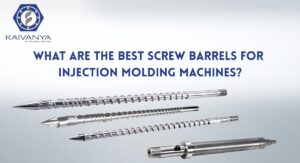


A screw barrel is the core plasticizing assembly inside an injection molding machine or plastic extruder. It accepts resin from the hopper, conveys it forward, applies heat and shear, blends the melt, and builds the pressure needed for molding or continuous extrusion. Plastics processors, machine rebuilders, and production teams depend on the right screw barrel to maintain stable output and consistent part quality. Its importance is easy to underestimate: when the screw geometry, barrel condition, or material selection does not match the polymer and process, quality problems, excess scrap, and unplanned downtime can follow.
How Does a Screw and Barrel Work in Injection Molding and Extrusion?
The assembly combines a precision-machined screw with a close-fitting barrel. Heater bands around the barrel supply heat, while screw rotation creates conveying, compression, and mixing action. In injection molding, the screw rotates to prepare a measured shot, then moves forward to inject the melt. In extrusion, it rotates continuously to deliver material through a die. Product categories include reciprocating injection molding screw barrels, single-screw extruder barrel sets, and parallel or conical twin-screw systems. Designs can be general-purpose or engineered for a particular resin, filler, output target, or mixing requirement. The main differentiator is not appearance; it is how accurately the metallurgy, geometry, clearance, and machine interface suit the real application.
What Are the Key Features of a High-Quality Screw Barrel?
A well-specified screw barrel balances strength, wear resistance, corrosion resistance, and heat transfer. Base steels, nitrided surfaces, bimetallic screw barrel linings, and hard-facing alloys are available, but the actual grade and treatment should be confirmed on the supplier’s data sheet. Screw flight profile, compression ratio, length-to-diameter ratio, mixing sections, venting, and feed geometry influence how material moves and melts. Precision outside dimensions, straightness, concentricity, and screw-to-barrel clearance support consistent operation and OEM compatibility. Diameter, overall length, drive end, nozzle or die connection, heater layout, thermocouple ports, and cooling zones can be manufactured to a verified drawing or matched sample for reliable processing.
What Are the Benefits of the Right Injection Molding or Extruder Screw Barrel?
The correct injection molding or extruder screw barrel improves process repeatability by delivering a uniform melt at a controllable rate. That helps operators reduce defects linked to poor mixing, unstable pressure, unmelted resin, overheating, or inconsistent shot size. Application-matched metallurgy protects high-wear surfaces when processing abrasive fillers or corrosive formulations, which can extend usable service life when supported by operation and maintenance. Accurate machine interfaces simplify installation and reduce adjustment during replacement. Just as important, monitoring wear helps teams plan maintenance before production becomes unstable. As clearance between the screw flight and barrel grows, material can leak backward, reducing conveying efficiency and making output or shot consistency harder to control.
Where Are Screw Barrels Used in the Plastics Industry?
Screw barrels are used wherever thermoplastics must be melted, mixed, and shaped. Injection molding systems rely on them for repeatable shots used in automotive components, packaging, medical products, electrical housings, appliances, and consumer goods. Extrusion machines use continuous plasticizing for pipe, profile, sheet, film, cable coating, and pellet production. Compounding and recycling operations may use twin-screw configurations to disperse pigments, combine additives, incorporate fibers or mineral fillers, remove volatiles, and reprocess reclaim. Each application creates a different buying requirement: clear or heat-sensitive polymers may need gentle handling, filled compounds require stronger wear protection, and frequent material changes may favor designs that are easier to clean.
What Technical Specifications Should Buyers Check?
| Specification | Details / Requirement |
|---|---|
| Product Type | Screw Barrel Assembly |
| Screw Diameter | Machine model and application specific |
| Working Length | As per machine design |
| L/D Ratio | Application and machine specific |
| Flight Geometry | Standard, barrier, mixing, or application-specific design |
| Compression Ratio | Polymer and processing requirement dependent |
| Mixing Design | Dispersive / distributive / application-specific |
| Barrel Bore | Matched to screw diameter and required clearance |
| Critical Clearances | As per approved component drawing and machine OEM specification |
| Drive Coupling | Compatible with existing machine drive |
| Mounting Dimensions | As per machine OEM drawing |
| Nozzle / Die-End Details | Machine and tooling specific |
| Base Material | 38CrMoAlA, EN41B, 42CrMo, H13 / SKD61, or application-specific material |
| Liner / Hard-Facing Alloy | Tungsten carbide, nickel-based, cobalt-based, Colmonoy, or application-specific alloy |
| Surface Treatment | Nitriding, hard-facing, bimetallic lining, or specified treatment |
| Hardness | As specified according to material, coating, and application |
| Heater Locations | As per barrel design and machine configuration |
| Sensor Locations | As per machine temperature-control arrangement |
| Cooling Arrangement | Air or liquid cooling, depending on machine design |
| Processed Resin Compatibility | Must be verified against the specific polymer formulation |
| Glass-Fiber Processing | Material and wear protection selected according to fiber loading |
| Flame-Retardant Materials | Alloy and surface treatment selected according to formulation |
| Recycled Content | Design selected according to recycled material characteristics |
| Corrosive Additives | Corrosion-resistant material/alloy selection required |
| Allowable Melt Temperature | As approved by machine OEM, resin supplier, and component design |
| Maximum Rotational Speed | As specified for the machine and screw design |
| Maximum Torque | As specified by the machine drive and approved screw design |
| Operating Pressure | Application and machine design dependent |
| Drawing Tolerances | As per approved engineering drawing |
| Final Configuration | Confirmed after machine, polymer, throughput, and operating-condition review |
How Do You Choose a Reliable Screw Barrel Manufacturer?
Choose a screw barrel manufacturer that requests process information before recommending a design. A credible supplier should review the polymer, additives, machine make and model, drawing or sample, wear pattern, production symptoms, and operating conditions. Ask for documented material grades, heat-treatment or lining details, dimensional inspection, hardness verification, and a final drawing for approval. Also confirm whether the supplier can reproduce OEM interfaces, optimize geometry for a defined application, support installation, and inspect worn components. Clear documentation and responsive technical support make quotations easier to compare and reduce the risk of buying a component that fits physically but performs poorly.
Contact Us
Need an injection molding screw barrel replacement or custom extruder screw barrel? Send your machine model, component dimensions or drawing, polymer details, additives, and concerns for an application review. Request a quote, compare material options, and confirm compatibility before production is interrupted. Talk to a screw barrel expert today.