

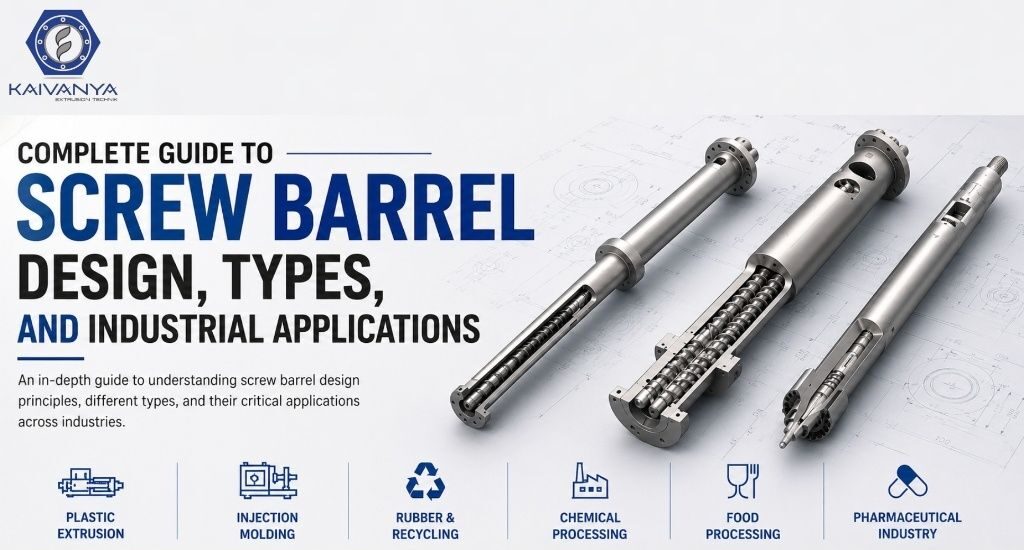
The performance of a screw and barrel assembly greatly influences the quality, efficiency, and consistency of production in modern plastic processing. Depending on whether the machine is used for extrusion, injection molding, blow molding, recycling, compounding, or profile manufacturing, etc., the screw barrel is one of the key components that plays a critical role in melting, mixing, conveying, compressing, and processing raw materials.
The ultimate guide emphasizes screw barrel types and design principles to help readers grasp their impact on plastic processing performance.
What Is a Screw Barrel?
A screw barrel is the main component in plastic extrusion and molding machinery. It features a rotating screw placed within a cylindrical barrel. The feeding system sends a range of plastic raw substances, along with granules, pellets, powders, masterbatch, additives, fillers, and recycled materials into the barrel. The material moves along a heated, compressed, melted, mixed, and homogenized screw as it rotates. The processed material is conveyed towards the die or mold, or processing head. An industrial screw barrel can affect melt quality, production capacity and rate, dimensional accuracy, energy consumption levels, cycle time duration, as well as the entire processing machine efficiency.
Since polymers differ in melting temperature, viscosity, flow characteristics, filler content, and processing required, screw barrels need to be designed according to machine type, material, and processing needed.
How Does a Screw Barrel Work?
The raw material enters the door of a barrel at first through the feeding hopper. Captured by the rotating screw, the material is picked up and pushed forward through the screw channel. They utilize external barrel heaters to generate the temperature, while mechanical friction and shear from the screws’ rotation provide supplementary heat. Moving forward, the material makes a change in the shape of the screw channel per the screw geometry. The fabric is compacted, melted, combined, and also made into an identical plastic melt. The processed material is then led to its metering section, where temperature, pressure, and flow are maintained constant before being fed into a die or mold. A high-performing plastic processing screw barrel needs to convey the material in a controlled manner, melt properly, mix effectively, generate stable pressure, and deliver reliable output.
Understanding Screw Barrel Design
Screw barrel design is one of the most important factors affecting plastic processing performance.
A well-engineered design, tailored to your specific polymer, production capacity, and machine specifications, helps you feel assured in achieving optimal processing results.
Carefully considering technical parameters like screw diameter, L/D ratio, and compression ratio enables you to feel more confident in designing effective screw barrels for your applications.
Screw Diameter
Screw diameter influences machine processing capacity and output, while the L/D ratio affects melting and mixing efficiency, guiding proper selection.
Larger screw diameters can generally process higher material volumes, while smaller screws are commonly used for precision applications and lower production capacities.
The correct diameter must match the machine design and production requirements.
L/D Ratio
The L/D ratio describes Screw length and screw diameter.
So a L/D ratio of 30:1 implies the screw length is about thirty times its diameter.
The L/D ratio is primarily determined by the amount of processing length available to permit melting, mixing, homogenization, and temperature control. But the ratio of choice is subject to your material and application.
Compression Ratio
The compression ratio indicates the ratio between channel depth in the feeding section and the metering section.
A proper compression ratio builds melting, pressure development, air removal one molecule at a time, and material homogenization.
If the compression ratio is inappropriate, it will lead to overheating, material damage, poor plasticizing quality, and pressure fluctuation or energy consumption.
Screw Flight Geometry
Screw flights transport material through the barrel.
Flight depth, pitch, clearance, width, and angle influence material movement, shear generation, pressure development, and processing efficiency.
Precision manufacturing of screw flights is essential for achieving consistent performance.
Screw Channel Depth
Channel depth determines how much material can be transported through different sections of the screw.
Deeper channels generally provide higher material carrying capacity, while shallow channels increase compression and shear.
The channel profile must be optimized according to the processed polymer.
Mixing Elements
Modern screw designs may incorporate specialized mixing elements to improve material distribution and dispersion.
Mixing sections are especially important when processing masterbatch, pigments, fillers, additives, recycled materials, engineering plastics, and polymer blends.
Main Zones of a Screw Barrel
A conventional screw is divided into three main zones: feed, compression, and metering, each critical for processing and product quality.
Feed Zone
The feed zone fills with and moves solid raw material from the hopper. Its main job is managing the constant supply of material; it prevents bridging, slippage, and uneven material flow. Feed section geometry is unique to the raw material, and depending on the raw ingredient supply chain, bulk density, particle size, and friction properties.
Compression or Transition Zone
The compression zone continuously decreases the depth of the screw channel. At this stage, solid plastic starts to melt as a result of barrel heating, friction, pressure, and mechanical shear. This reduces the air trapped between the material particles and causes the polymer to melt.
Metering Zone
The polymer melt is provided in a homogenous manner with a temperature and pressure-controlled metering zone. The design of the metering zone is vital to stable output, consistent melt quality, and even product dimensions.
Major Types of Screw Barrels
Different plastic processing technologies require different types of screw barrels. Understanding their characteristics can help manufacturers select the correct configuration.
Single Screw Barrel
Uses one rotating screw and one screw barrel. This type is one of the configurations used frequently in a plastic extrusion machine. Single screw systems are easy to operate, offer good and reliable operation, lower maintenance requirements, and good energy efficiency. They are widely employed in pipe, sheet, film, profile extrusion, and cable, as well as in general-purpose plastic processing. It can be used for many thermoplastic materials, such as PE, PP, PVC, PS, and ABS.
Twin Screw Barrel
A twin screw barrel uses two screws operating inside a specially designed barrel. Twin screw systems provide superior mixing, compounding, dispersion, devolatilization, and material processing capabilities. Depending on the application, twin screws may rotate in the same direction or opposite directions.
Co-Rotating Twin Screw Barrel
In a co-rotating twin screw barrel, both screws rotate in the same direction. This design provides excellent distributive and dispersive mixing performance. Co-rotating systems are widely used for polymer compounding, masterbatch manufacturing, engineering plastics, filler processing, color mixing, reinforcement materials, and plastic modification.
Counter-Rotating Twin Screw Barrel
A counter-rotating twin screw barrel is one where the screws rotate in opposite directions. These systems are capable of producing stabilized pressure and know how to convey materials in a controlled manner. They are extensively used in the manufacture of PVC pipe, rigid and flexible PVC profiles, window frames, doors, panels, and HPVC products.
Injection Molding Screw Barrel
Injection moulding screw barrels are specially designed for the plastic injection moulding machine. The screw will rotate to melt and refine plastic material before moving axially forward to inject viscous polymer into the mold cavity. The performance of an injection screw barrel is directly related to cycle time, shot consistency, plasticization process, and even product strength, surface finish, and dimensional accuracy. Electro-Optical Devices Market Segmentation via Application. The various applications of these systems include automotive components, electrical products, packaging, household products, consumer goods, medical components, industrial parts, and technical plastic products.
Extrusion Screw Barrel
The extrusion screw barrel is made for in-line plastic processing. In the idealized version of a continuously working machine, raw material continuously in a stream must flow through the processing zones and out through a die to become products having almost the same cross-sectional profile. As it got to plastic pipes, films, sheets, cables, profile rubber tubing, and pellets, compounds recycling applications, and extrusion screw barrel. Extrusion processing often requires stable output with consistent melt quality.
Blow Molding Screw Barrel
The blow molding screw barrel is for hollow plastic production. Screw barrel melting and processing the plastic material, then a parison or preform was made by extruding it into a mold to inflate with compressed air. Some common applications are bottles, containers, drums, tanks, automotive ducts, and industrial packaging & hollow plastics components. A well-designed blow molding screw barrel will enable uniform melt quality, parison formation stability, consistent wall thickness, and better strength of the product.
Bimetallic Screw Barrel
A bimetallic screw barrel is engineered for demanding applications involving abrasive, corrosive, filled, or recycled materials. The barrel bore is protected using a wear-resistant alloy layer, while the screw may receive specialized hard-facing, alloy coating, or surface treatment. Bimetallic solutions provide improved wear resistance, corrosion protection, longer operating life, reduced maintenance frequency, and better performance under severe processing conditions. They are commonly recommended for glass-filled polymers, calcium carbonate compounds, engineering plastics, recycled materials, flame-retardant compounds, masterbatches, and other abrasive formulations.
Parallel Twin Screw Barrel
A parallel twin screw barrel uses two screws positioned parallel to each other. This configuration provides high output capacity, effective material processing, and stable production performance. Parallel twin screw barrels are commonly used for PVC pipes, profiles, boards, sheets, pellets, and high-output extrusion applications.
Conical Twin Screw Barrel
A conical twin screw barrel uses screws with a gradually changing diameter. The larger feed section improves material intake, while the smaller discharge section helps develop controlled pressure. These systems are commonly used for PVC pipes, profiles, panels, doors, windows, and rigid PVC processing.
Vented Screw Barrel
A vented screw barrel contains a special venting section designed to remove moisture, gases, air, and volatile substances from the polymer melt. Vented systems are useful for recycled materials, hygroscopic polymers, moisture-sensitive materials, and applications requiring improved product surface quality.
Screw Barrel Materials and Surface Treatments
Material selection is an important factor influencing screw barrel life, processing performance, and wear and corrosion resistance.
Nitrided Steel
Industrial screw barrels are generally made of nitrided steel. Nitriding includes a hard surface, which helps maintain wear resistance, fatigue strength, and corrosion resistance. Nitrided screw barrels are suitable for a range of general-purpose processing of plastics.
Bimetallic Alloys
The barrel bores of bimetallic barrels contain internal wear-resistant alloy layers. In order to prevent abrasion, corrosion, high temperature, and aggressive processing conditions, depending on application requirements, specialized alloys are selected.
Tool Steel
Tool steels are chosen for applications that need high hardness, mechanical strength, and wear resistance. They may be utilized for screws, tips, check rings, blending components, and other key parts.
Hard-Facing Alloys
Hard-facing treatments are used on screw flights and other areas subjected to high wear. Depending on the processing conditions, nickel-based, cobalt-based (or others) alloy systems contain carbide.
Chrome Plating
The three main benefits of chrome plating are the creation of a smooth surface, increased resistance to electrolytic corrosion, and reduced adherence. This is usually employed for the workings of corrosive polymers and cases in which smooth material flow matters.
Industrial Applications of Screw Barrels
Screw barrels find industrial applications in almost all branches of the plastic, rubber, polymer compound, etc., processing industry.
Packaging Industry
It has characteristic uses as screw barrels in plastic films, containers/bottles/caps/closures/sheets, and packaging part manufacturing industries. Regularity of melt quality is a must-have for keeping homogeneous dimensions and product strength.
Automotive Industry
From this processing technology, such parts as dashboards, bumpers, interior components, electrical housings, connectors, and ducts, as well as under-the-hood components, are manufactured by automotive manufacturers. Screw barrel solution for wear-resistant engineering plastics and glass-filled polymers
Pipe and Profile Manufacturing
Commonly used for the production of PVC, HDPE, PPR, CPVC, and other varieties of plastic pipe extrusion screw barrels. They are also used in profiles, window frames, doors, and panels, as well as in construction products.
Recycling Industry
The nature of plastic recycling is one that involves handling of contaminated, abrasive, mixed, and varying raw materials that only make demands on screw barrels. In such demanding recycling applications, wear-resistant and bimetallic screw barrels can offer a more affordable service life.
Masterbatch and Compounding Industry
Twin screw extruders are extensively used for the production of color masterbatch, filler masterbatch, additives, reinforced polymers, engineering compounds, and modified plastics. The screw geometry in extrusion is a critical factor that affects dispersion and compound quality.
Medical and Pharmaceutical Products
Syringes, laboratory parts, packaging, parts of a diagnostic device, and other medical plastic items are made by a precision plastic processing machine. Things being repeated? — Accurate temperature control, repeatable processing, and consistency of material are must-haves.
Electrical and Electronics Industry
Screw barrels are a type of device used to convert the raw materials into electrical housings, switches, connectors, cable insulation, appliance parts, and electronic components.
Construction Industry
Plastic processing machinery manufactures pipes, profiles, panels, and slabs, insulation materials, waterproofing membranes, flooring products for various applications (roofing systems), and repair and reconstruction castings used to manufacture industrial parts.
Common Screw Barrel Problems
Even a high-quality screw barrel can develop performance problems due to continuous operation, abrasive materials, incorrect settings, contamination, or inadequate maintenance.
Excessive Screw and Barrel Wear
Wear increases the clearance between the screw and barrel. As clearance increases, material leakage and backflow can occur, reducing pressure generation and production capacity.
Poor Plasticization
Incomplete melting can result from incorrect temperature settings, unsuitable screw geometry, excessive production speed, damaged heaters, or worn screw barrel components.
Unstable Production Output
Fluctuating output may result from inconsistent material feeding, temperature variations, excessive wear, drive problems, or incorrect screw design.
Black Spots and Material Degradation
Material may remain trapped inside dead zones and degrade due to excessive temperature or residence time. Contamination, improper cleaning, and damaged processing surfaces can also contribute to black spots.
Excessive Energy Consumption
Worn components, incorrect screw geometry, excessive pressure, unsuitable operating conditions, and poor material flow can increase machine power consumption.
Corrosion
PVC, flame-retardant materials, certain additives, and chemically aggressive polymers can damage standard screw barrel surfaces. Selecting corrosion-resistant materials or surface treatments is essential for these applications.
How to Select the Right Screw Barrel
Selecting the correct screw barrel for plastic machinery requires a detailed evaluation of the processing conditions.
Important factors include:
The type of polymer being processed.
Machine make, model, and processing technology.
Required production output.
Screw diameter and L/D ratio.
Material viscosity and melt flow characteristics.
Percentage and type of fillers.
Presence of glass fiber or abrasive additives.
Processing temperature and pressure.
Required mixing and plasticization performance.
Corrosion resistance requirements.
Expected operating life.
Availability of technical support, repair, and replacement services.
Manufacturers processing standard virgin polymers may achieve excellent results with nitrided components. However, businesses processing abrasive, highly filled, corrosive, or recycled materials may benefit from bimetallic screw barrel solutions.
Why Custom Screw Barrel Design Matters?
Standard screw designs alone cannot deliver premium performance for every polymer, machine, and processing application. The screw barrel design is customized for certain production circumstances. These can be optimized to screw geometry, compression ratio, mixing sections, materials selection, heat treatment, and surface hardness. A well-engineered custom solution will deliver increased production capacity, superior melt quality, cooler operating temperatures, reduced energy consumption, enhanced component life, fewer defects, and enhanced production stability. They are also crucial for manufacturers who face consistent issues with standard machine parts in the production process.
Benefits of Choosing the Right Screw Barrel Manufacturer
Working with an experienced screw barrel manufacturer in India can provide significant technical and commercial advantages.
A reliable manufacturer should understand polymer processing behavior, screw design engineering, metallurgy, heat treatment, precision manufacturing, quality inspection, wear mechanisms, and industrial application requirements.
The manufacturer should also be capable of supplying customized solutions based on machine drawings, samples, operating conditions, raw materials, and production problems.
Strong technical support is particularly important when businesses want to improve output, reduce recurring wear, solve plasticization problems, or process new materials.
Conclusion
This screw barrel is the core of many plastic processing machines. The design, material, geometry, manufacturing accuracy, surface treatment, and maintenance condition of the mold have a direct impact on production efficiency, product quality, and energy consumption.
By learning about the different varieties of screw barrels, such as single screw barrels, twin screw barrels, injection molding screw barrels, extrusion screw barrels, blow molding screw barrels, and bimetallic screw barrels, manufacturers can choose solutions that fit their processing needs.