

What is The Bimetallic Screw?
A bimetallic screw is an advanced extrusion component engineered to deliver outstanding wear resistance, corrosion protection, and reliable processing performance in demanding plastic manufacturing environments. It combines a strong base material with a specially selected alloy layer on critical working surfaces, helping protect the screw against abrasive fillers, corrosive polymers, and continuous high-temperature operation. Bimetallic extrusion screws are widely used in plastic extrusion, compounding, masterbatch, recycling, and other applications where conventional screws may experience premature wear. For manufacturers focused on consistent output, longer component life, and lower maintenance costs, a properly engineered bimetallic screw can provide a powerful
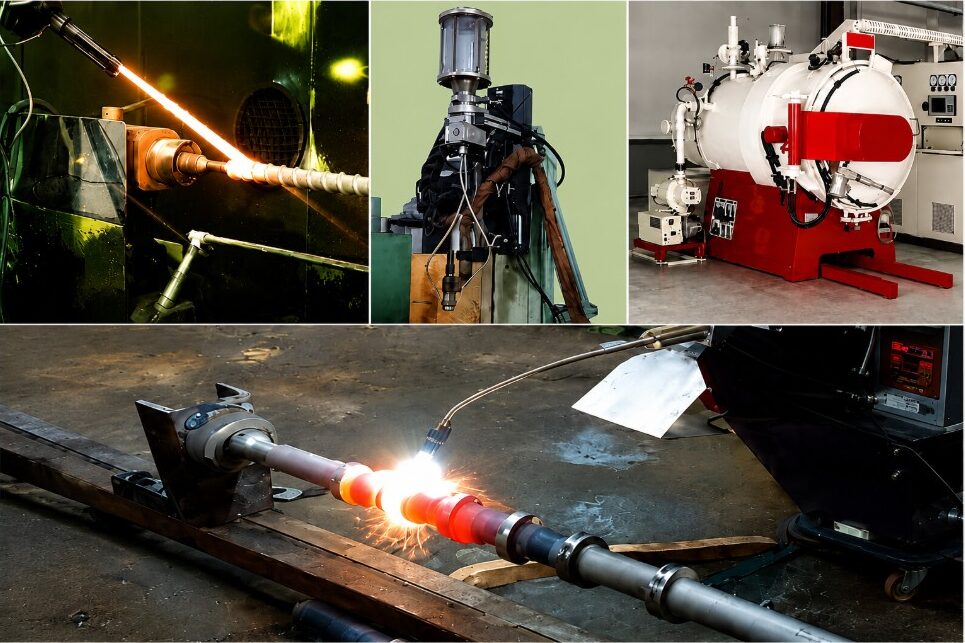
Product Overview
A bimetallic screw is manufactured using two different material systems to achieve a practical balance between mechanical strength and surface durability. The screw core provides structural integrity and resistance to mechanical loading, while a wear-resistant or corrosion-resistant alloy is applied to selected working areas. Depending on the process, alloy options may include nickel-based, cobalt-based, or tungsten-carbide-containing materials.
The screw geometry is designed according to the extrusion machine, polymer formulation, throughput requirement, and processing conditions. Available configurations can include single-screw extrusion screws, twin-screw components, barrier screws, mixing screws, and specially engineered screw profiles. The major advantage is that the working surface receives enhanced protection without compromising the strength required for demanding extrusion operations.
Key Features
High-quality bimetallic extrusion screws are engineered for applications where wear, corrosion, and heat can significantly affect conventional screw surfaces. Typical features include a robust steel base, specially selected alloy protection, precision-machined flight geometry, and application-specific surface treatment.
Depending on the design and manufacturer, common base materials may include 38CrMoAlA (SACM 645), EN41B, 42CrMo, 34CrAlNi7, H13, or SKD61. The working surface can be reinforced with advanced alloy systems selected according to the material being processed.
Bimetallic screw designs are available in different diameters, lengths, L/D ratios, compression ratios, mixing sections, and feed geometries. Proper engineering helps maintain dimensional stability, improve material conveying, and support consistent melt processing under demanding operating conditions.
Benefits
Choosing a bimetallic screw can provide significant operational advantages for extrusion manufacturers. The enhanced surface protection helps reduce wear caused by abrasive materials such as glass-filled polymers, mineral-filled compounds, calcium carbonate, and recycled materials. Improved corrosion resistance can also be valuable when processing aggressive polymers or additives.
Longer wear life can help reduce the frequency of screw replacement, minimizing unplanned downtime and maintenance interruptions. Consistent flight dimensions can support stable material conveying and predictable processing performance throughout the component’s service life.
For high-volume production, these advantages can contribute to better process reliability, improved productivity, and potentially lower total operating costs. The real benefit, however, depends on correct material selection, screw geometry, processing conditions, and manufacturing quality.
Applications
Bimetallic screws are suitable for a broad range of extrusion applications where conventional screw materials may face accelerated wear or corrosion. They are commonly considered for plastic compounding, masterbatch production, polymer processing, recycling, pipe extrusion, profile extrusion, sheet extrusion, film production, and filled polymer processing.
They are particularly valuable when processing engineering plastics, highly filled compounds, abrasive additives, recycled polymers, and formulations containing glass fibers or mineral fillers. In compounding applications, the screw must withstand continuous mechanical and thermal stress while providing effective conveying, melting, mixing, and dispersion.
Manufacturers can select the screw construction and alloy system according to their specific polymer, filler concentration, production volume, machine configuration, and expected operating environment.
Specifications / Technical Details
| Parameter | Typical Specification / Consideration |
|---|---|
| Product Type | Bimetallic Extrusion Screw |
| Screw Type | Single Screw / Twin Screw |
| Base Materials | 38CrMoAlA (SACM 645), EN41B, 42CrMo, 34CrAlNi7, H13 / SKD61 |
| Alloy Options | Nickel-Based, Cobalt-Based, Tungsten-Carbide-Based, depending on application |
| Screw Diameter | Approximately 20 mm – 300 mm, depending on machine |
| L/D Ratio | Approximately 18:1 – 40:1, depending on extrusion system |
| Surface Hardness | Can reach approximately 62–68 HRC in suitable hardened configurations |
| Configuration | Standard or Customized Screw Profile |
| Geometry | Conveying, Barrier, Mixing, Kneading and Application-Specific Designs |
| Customization | Diameter, length, flight profile, compression ratio, coating/alloy, and machine compatibility |
Why Choose a Bimetallic Screw Manufacturer & Supplier?
Selecting the right bimetallic screw manufacturer is essential because performance depends on much more than the alloy used. Accurate dimensional machining, metallurgical control, correct heat treatment, alloy bonding, surface finishing, and profile inspection all influence service performance.
An experienced manufacturer should be capable of producing application-specific screw geometries and recommending suitable base and alloy materials according to the customer’s processing requirements. Quality inspection at critical manufacturing stages can help ensure dimensional accuracy, reliable surface performance, and compatibility with the intended extrusion machine.
Contact Us
Upgrade your extrusion process with a high-performance bimetallic screw engineered for demanding production conditions. Share your machine model, screw dimensions, polymer, filler composition, and processing requirements to identify the appropriate screw construction. Request a quote today and get customized technical guidance for your extrusion application.